
Bartın
- Black Sea Region
About Bartın
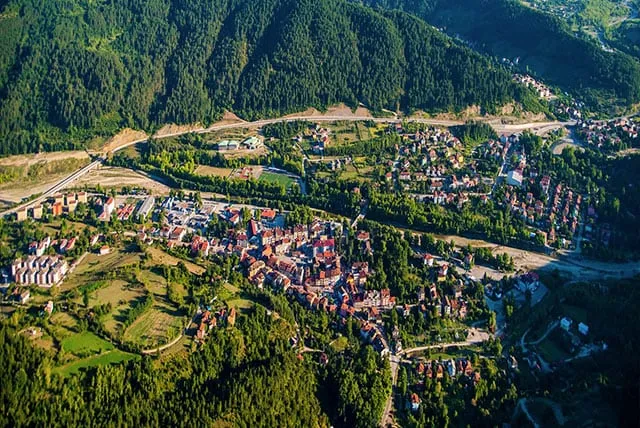
Bartın, in the Western Black Sea Region, faces the Black Sea along its 59-kilometre northern coastline. Bordered by Kastamonu to the east, Karabük to the south-east and Zonguldak to the west, Bartın covers an area of 2,143 square kilometres.
Summers in the area are warm and winters cool, and the city has a mild maritime (Black Sea) climate. Its closeness to the sea and the fairly low mountain ranges running parallel to the coast generally reduce temperature differences along the coastal strip, increase humidity and leave it open to air masses from the Balkans.
Bartın's famous dishes and desserts
Among the factors that shape Bartın's culinary tradition, the people's outlook on life, their customs and traditions, shared character, cooking techniques, climate and ecological balance play a large part.
Bartın's many delicious dishes include meat, vegetable, milk, pastry and olive-oil dishes, as well as pilafs, soups and desserts.
Another notable point is the many varieties of the same kind of food: for example, there are more than 10 kinds of dolma and pilaf.
Research on Bartın cuisine has found more than 100 dishes, which clearly shows the richness of the local cuisine.
| Su böreği | Fish and Amasra salad :) |
Bartın dishes include meat, vegetable, milk, pastry and olive-oil dishes, as well as pilafs, soups and desserts. Another notable point is the many varieties of the same kind of food: for example, there are more than ten kinds of dolma and pilaf. Research on Bartın cuisine has found more than a hundred dishes, which clearly shows the richness of the local cuisine.
Places to visit in Bartın
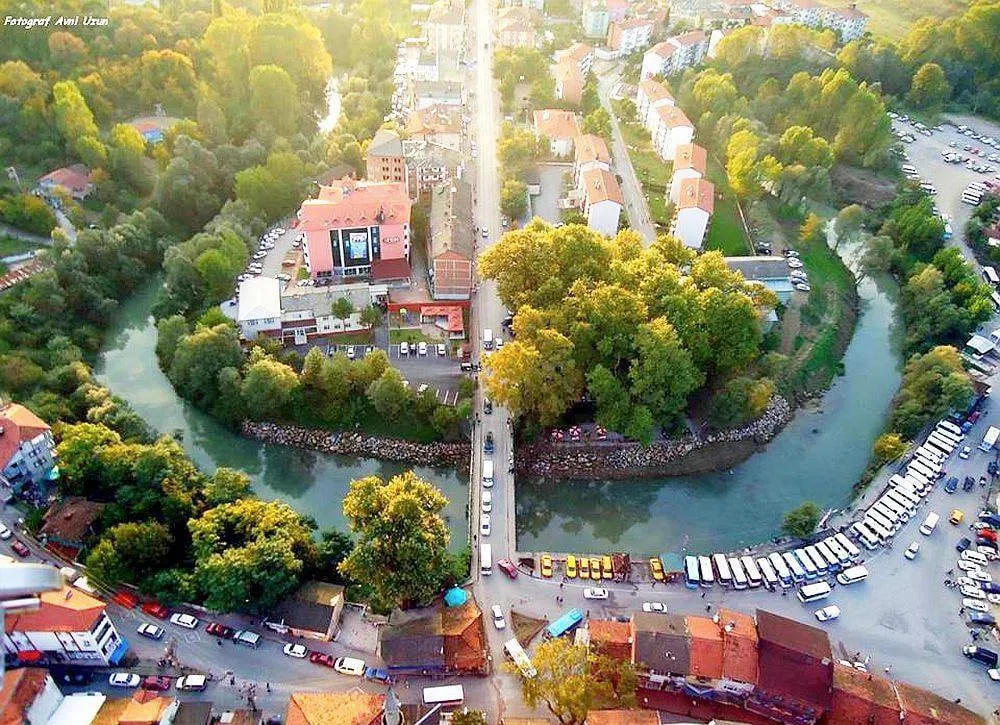
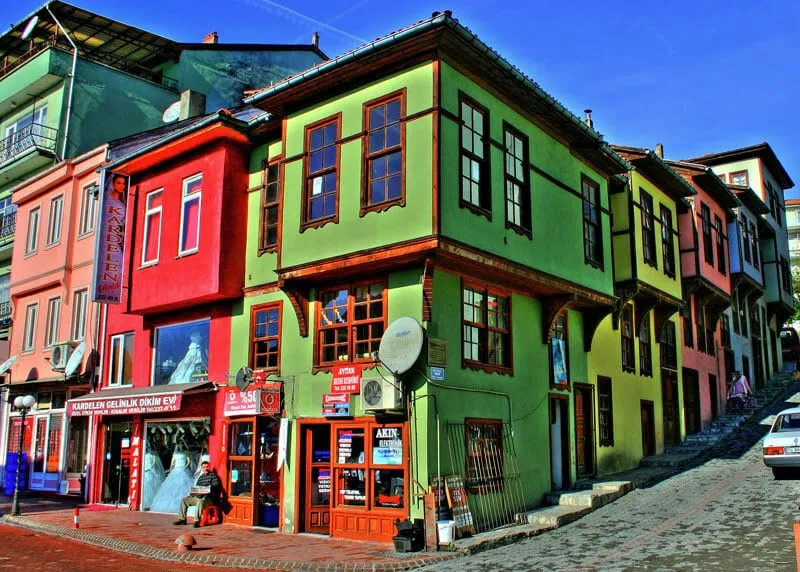
With its national parks, waterfalls, sea, endless forests, deep-rooted history, centuries-old plane trees, narrow streets lined with wooden houses and highland pastures, Bartın is like a natural film set. Home to many civilisations in the past, Bartın, whose ancient name was Parthenion, took its name from the virgin goddess Athena: the Virgin City. If you want to be at one with nature, follow the traces of the past and have an unhurried holiday, Bartın is exactly what you are looking for.
Historic monuments: As well as for its natural beauty and cultural heritage, lovely Bartın stands out for the historic works that carry traces of the past into the present. The best known and most striking are the Amasra Hamam, the City Hamam, the Dervişoğlu Han, the Taşhan, Tekkeönü Castle and Amasra Castle.
Beaches and marinas: Bartın's beaches and marinas liven up the area and give it colour. You can include Kurucaşile Harbour, İnkumu Beach, Çakraz Beach, Amasra Beach, Çambu Beach, Güzelcehisar Beach and Amasra Harbour in your trip.
Mosques and churches: Bartın has many mosques and churches that have defied the centuries. The Church of Aya Nikolas, the Tomb of Ebu Derda, the İçkale Masjid, the Şadırvan Mosque, the Halilbey Mosque, the Küçüktepe Martyrium in Amasra and the İbrahimpaşa Mosque are among the best known. You absolutely must include them on your list and see Bartın's history up close.
Highland pastures and national parks: If you want to be surrounded by Bartın's natural beauty and get giddy on oxygen, you must visit its yaylas (highland pastures) and national parks. Gezen Yaylası, the Küre Mountains National Park shared by Bartın and Kastamonu, Uluyayla and Ardıç Yaylası are foremost among the places that give the area colour and beauty.
Places to visit in Bartın: historic sites
Güzelcehisar Castle
Güzelcehisar Castle, in the village of Güzelcehisar in Amasra, is a building left by the Genoese. It is said to have once been used as the watchtower of the historic city of Kromna.
The inside of the building is now entirely stone. When you climb to the top of the castle, you are met with the unique view of Güzelcehisar village, and looking north, the enchanting view of the Black Sea immediately captivates you.
In the 1900s Güzelcehisar Castle was in fact a very large structure, but today only a single tower is still standing.
It is quite hard to reach the castle by car, so you need to park about 1.5 kilometres away and walk.
If you find yourself in Amasra, don't forget to add Güzelcehisar Castle to your list of places to see. We wish you a good holiday in advance.
Güzelcehisar lava columns
The lava columns in Amasra, which give Güzelcehisar its significance with their 80-million-year history, are one of our country's rare beauties. With diameters of 50–100 cm and heights of over 30 metres, the lava columns are among the world's rare and well-developed natural formations.
The Güzelcehisar lava columns are known to be lava flows from a very old volcano, and one of the 3 oldest volcanic remains in the world is also found here.
We recommend you make sure to see the very impressive Güzelcehisar lava columns. We wish you a good holiday in advance.
Tavşan Adası (Rabbit Island), Amasra
Tavşan Adası is one of Amasra's most important islands. It lies opposite the historic Kemere Bridge in Amasra and contains historic remains left by the Genoese, such as a Byzantine church and monastery. It takes its name from the rabbits that locals released on the island years ago and that still live there.
At the eastern tip of Tavşan Adası there is a rock arch, which is said to have an interesting story: in very ancient times, people with various illnesses were taken through the gap in the rock arch by rowing boat or motorboat in the hope that they would be cured.
Tavşan Adası is also the only island in Amasra with no connection to the mainland. On the north side of the island is a 70-metre cave that you can swim through. You can come to Tavşan Adası on boat tours from Amasra and spend a lovely time with the rabbits on this magnificent island.
If you find yourself in Amasra, please don't forget to add Tavşan Adası to your list. We wish you a good holiday in advance.
Güzelcehisar Bay
Güzelcehisar Bay, with one of the most beautiful stretches of coast on the Black Sea, should definitely be among the new places you discover this year.
Güzelcehisar Bay in Bartın is one of the largest beaches on the Black Sea, and it is also the beach where the people of Bartın spend most of their time. Although the bay is only about 5 kilometres from İnkumu, there is no settlement in the area, so its nature has survived unspoilt.
It is especially lovely in July and August. It has a fine sandy beach and water that is shallow at first and deepens as you go out. Güzelcehisar Bay has been declared a Natural Protected Area so that its nature will remain unspoilt in the future.
There are no sunloungers or umbrellas, so bring your own things and enjoy a pleasant time at Güzelcehisar Bay.
Fatih Mosque, Bartın
The Fatih Mosque in Amasra, Bartın, was first built as a church. A 9th-century work, the building was converted into a mosque after Sultan Mehmed the Conqueror conquered Istanbul.
Although it is one of the churches that best reflect Byzantine masonry, it was repaired in the periods after its conversion and has moved away from its original form. The mosque has a vaulted roof. Still preserving its historic value amid Amasra's legendary natural beauty, the Fatih Mosque can be included in your tours of the town.
You can find out about other places to visit in the town on our pages on Direkli Kaya, the Kuş Kayası Road Monument, the Amasra ancient theatre and the Amasra Museum.
Gürcüoluk Cave
Gürcüoluk Cave is one of the places of tourist value in Amasra, Bartın. About 10 kilometres from Amasra, the cave is 169 metres long.
Visited by tourists throughout the year, Gürcüoluk Cave consists of a single gallery. Its dripstone columns have formed small chambers, and as you walk through the cave the stalactites, columns and stalagmites will create a different world for you.
Gürcüoluk Cave is very easy to reach: you can get there from the Karakaçak and İnpiri village turn-offs on the Amasra–Çakraz road. To see Amasra's hidden beauties, be sure to make time for Göldere Waterfall, Direkli Kaya and its lovely beaches too.
Direkli Kaya
Direkli Kaya, in Bartın's Amasra district, is a tourist sight with a magnificent sea view.
It is 7 metres long, and from here you can see a pool connected to the sea, steps carved into the rock and a marble pier. Direkli Kaya was actually built to light and watch the sea, and it is known to have been built by the Genoese. It is one of Amasra's beauty spots, like the Kuş Kayası Road Monument, Gürcüoluk Cave, Amasra Lighthouse and Göldere Waterfall… On your Amasra holiday you should definitely see Direkli Kaya and the view it commands.
Ulukaya Waterfall
Ulukaya Waterfall in Bartın is in Ulus district, and the trip there will be very special.
When you see Ulukaya Waterfall pouring from a height of 20 metres amid lush greenery, you will certainly be enchanted. The waterfall joins the Ulus stream and is among the places tourists always stop at to see its panoramic beauty. Its flow drops in summer and, by contrast, increases considerably in winter.
There are no facilities at Ulukaya Waterfall. Flowing through a canyon, its surroundings are full of details waiting to be discovered. If you are planning a holiday in Bartın, you should definitely go and listen to the unique music of Ulukaya Waterfall. Then, by visiting Göldere Waterfall, the Kuş Kayası Road Monument, Kapısuyu Beach and İnkumu Beach, you can both cool off and enjoy the sun on your holiday and savour the area's natural beauty.
Göldere Waterfall
Amasra, set in the loveliest spot on the Black Sea within Bartın's borders, hides a huge piece of paradise.
Without doubt, Göldere Waterfall is one of those pieces. As you visit it, the flowing water will touch your veins not like a sound from outside but like feelings flowing inside you. Small as it is, Göldere Waterfall has a great effect; you can never tire of watching it and its beauty. You can visit this waterfall on a trip you organise.
Kapısuyu Beach
Amasra, one of the most wonderful places on the Western Black Sea, is tucked away in Bartın, surprising with its authentic character and offering a paradise that envelops its guests. If you continue along the coast from Amasra, the district called Kurucaşile will show you a wonderful beach.
Those who know will tell you: Amasra's beaches are wonderful, and the beaches of this area show themselves in Kurucaşile too, cooling in their waters those who want to escape the burning sun. They make those who see them wonder how much effort God put into creating this area.
Kapısuyu Beach is one of the most important parts of this spot. With its turquoise colour in harmony with all the other colours of nature, the beach makes you feel as if you are somewhere that does not exist. It is fantastical, reminiscent of a very famous painting by a famous painter. Holidaying here is different: once you get a taste of it, you can never give it up. Seeing this beauty will certainly make you feel unusual emotions.
Kuş Kayası Road Monument
The Kuş Kayası Road Monument, within Bartın's Amasra district, is 4 kilometres from the district centre.
Located on the Amasra–Bartın road, the monument is important as the only road monument in Anatolia.
Made for the Roman emperor by the governor of Bithynia, the monument consists of a statue of a king, two inscriptions and an eagle figure.
A roadside resting place, the road monument was built in the Roman imperial period, in the time of Tiberius Claudius Germanicus, by Gaius Julius Aquila, who was then appointed governor of Bithynia and Pontus.
Part of the Roman road network and made in memory of the emperor, the road monument consists of a statue of a king carved into the rock, inscriptions that complement the Roman eagle of sovereignty, and rock niches. A valuable part of peaceful and incomparable Amasra, the Kuş Kayası Road Monument is just one of the places worth seeing.
Amasra Lighthouse
Amasra, a rich settlement, is different and surprising in every aspect. This area of Bartın has a beauty all its own with the Amasra Lighthouse.
Despite its ancient history, Amasra continues to attract great interest for tourism. It is still beautiful, still charming and still warm…
During your holiday, especially in the evening, climbing up to the Amasra Lighthouse on Boztepe to watch the little lights brightening the evening dark and its unique view will give you a special feeling. Watching every second of the sunset and every corner of Amasra from here will bring you calm and serenity.
Amasra Beach
Amasra Beach, in Bartın's Amasra district and sharing its name, lies north of the town centre.
With its deep-rooted history, old buildings and natural beauty, Amasra is still a holiday centre despite the years. The coves hidden among these beauties are each about 200 metres apart. Amasra Beach, which stands out among them, invites those who want a quiet holiday into its peaceful atmosphere.
Enjoy the trio of sun, sand and sea in the waters of the Black Sea. Here you can also visit Amasra Castle and enjoy some different and pleasant moments.
İnkumu Beach
İnkumu Beach, extraordinarily beautiful and reminiscent of paradise, is one of Bartın's best-loved places.
With its wonderful coves and spotless sand, İnkumu Beach attracts great interest for its water with few waves.
When you climb to the top of the mountain, the sea where blue and turquoise meet and the forests displaying their greenery create a unique view.
When you watch the dance of colours from that spot, you will feel it doing your soul good. There are hotels ready to host you here. If you want to holiday somewhere different, this is definitely the place for you.
Bartın: a must-see on a trip to Amasra is the market, now a tradition in Amasra, held every Tuesday and Friday, where products made and prepared by local women are displayed and sold.
Çekiciler Çarşısı, Amasra
The Çekiciler Çarşısı is a small market in central Amasra selling handmade local gifts made with great care.
The rare woodwork products in this market are worth seeing.
Bakacak viewpoint, Amasra
Rather than taking the first turn-off into Amasra, if you carry straight on, this is where you first see Amasra from the road. Because of the lie of the land, you can watch the whole of Amasra from a bird's-eye view here.
At Bakacak, people make a short stop to say hello to Amasra on arrival and goodbye on leaving.
The Weeping Tree, Amasra
The tree on Boztepe in Amasra releases moisture taken from the sea through its leaves a few times a year as a drizzle or drips. Its name comes from this.
Boztepe, Amasra
Boztepe has Amasra's finest view. If you love nature and feel wistful at sunset, this is a place you should go on your Amasra trip.
Delikli Şili, Amasra
An interesting natural wonder you will see in Amasra. The hole that has opened in the middle of the rock is astonishing. According to legend, its name comes from the young lovers Delkianus and Shilla.
Today it has become a place where people make a wish as they pass in front of it on a boat.
Amasra District Governor's House
The building, now used as the residence of the district governor (kaymakam), was built in 1884 inside the castle as a primary school (iptidai mektep) by İsmail Bey, mutasarrıf of Bolu.
Preserved to the present day, it is one of the places to see on your Amasra trip.
Kemere Bridge, Amasra
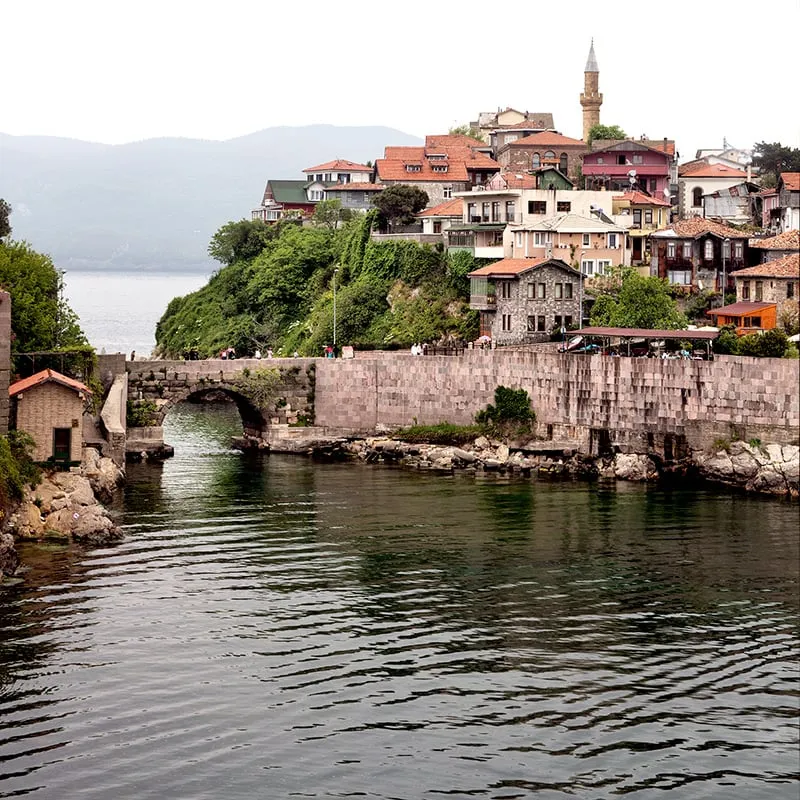
A bridge built in the Roman period in Amasra, linking the Sormagir and Boztepe neighbourhoods.
Because the bridge is still in use, it has been restored.
Küçük Kilise (Small Church), Amasra
The building in Amasra, now used as a culture and arts centre, was built in the 19th century. It is inside Amasra Castle.
Edhem Ağa Mansion, Amasra
Completed in 1889, the building is important as an original structure that has survived in Amasra to the present day.
Edhem Ağa, a Muslim investor, after acquiring a considerable fortune, had this mansion, designed in Istanbul, built by masters from Safranbolu on a plot he bought in Amasra.
Amasra Castle
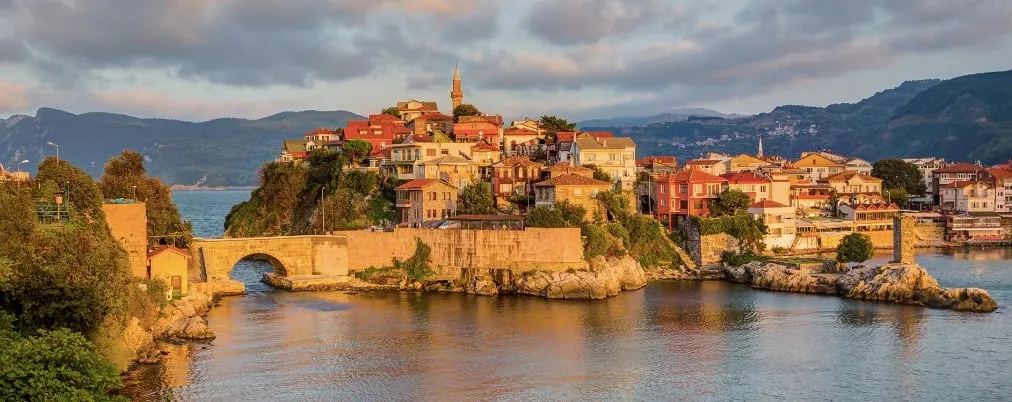
The castle on the shore in central Amasra consists of two main structures, the Zindan and Sormagir castles.
Built in the Roman period for its strategic position and to protect the city, the castle was repaired and used in the Byzantine, Genoese and Ottoman periods because of its importance.
Genoa Castle (Cenova Şatosu), Amasra
The Cenova Şatosu is the inner citadel that the Genoese family turned into a palace. Its most interesting feature, the entrance gate, bears the coats of arms of the families who ruled Amasra, preserved in all their beauty to the present day.
You reach the château by going up from the large harbour in central Amasra.
Kemerdere Bridge, Amasra
The bridge, in the walnut valley 3 km from Amasra on the Bartın–Amasra road, is part of the roads built in the Roman period.
It is included among the historic sites on Amasra tours and is visited.
Amasra ancient theatre
Only the niches of the theatre, south of Aya Yorgi hill in Amasra, are still standing today.
Source: https://www.gezilebilecekyerler.com/bartinda-gezilecek-yerler/
Culture and arts in Bartın
Bartın folklore
Bartın's folk dances, usually performed separately in groups of 4 or 6, include most notably:
- Mavili
- Dıv Dıv
- Kavşak suyuna giderken
- Haydah Nirinay
- Bahçelerde Patlıcan
- Gide gide
- Elma aldım Bartın'dan
- Bartın çiftetellisi
Although the traditional features of Bartın's 200-year-old local dress have completely disappeared from men's clothing, they are relatively well kept alive in women's clothing and jewellery.
Men's dress: In the town it consisted of baggy trousers with cavalry-style patches, a linen or woollen (şayak) jacket, a collarless shirt (mintan), a waistcoat and a sash. On the feet, yemeni or çapula shoes were worn. In rural areas, zıpka trousers and çarık (rawhide sandals) were preferred.
Women's dress: Women in the town wore a göynek (shift), şalvar and a printed scarf of old design, while young girls wore an Uskufa or Kutnu waistcoat, a silk göynek, şalvar, a tombak (gilded copper) belt, a Çatku Tel Kırma scarf made with a special technique, and a tiara. Women in the countryside wore şalvar called "şilityan", decorated with flower patterns except on the skirt, and dresses of printed cotton and flannel; on their heads they wore a headscarf of fine cloth, also flower-patterned, covered by an "örtme" reaching to the waist. For the lower body, a "peştamal" of woven cotton or silk was knotted at the waist to cover the şilityan, those made in Rize being preferred. Low-heeled yemeni slippers were the shoe of choice.
BARTIN ÇİFTETELLİSİA kind of folk dance common in the Balkans and the western regions of our country, especially widespread in Bartın, Zonguldak and Bursa. The tunes and rhythms are similar, but the figures differ.
Danced until the end of the 18th century to the davul, zurna and folk songs, and from the early 19th century to instruments such as the oud, violin, tambourine, clarinet, flute, cümbüş and darbuka, the dances' real music is the folk songs.
Symbolising the grace and beauty, vitality and liveliness of women, these dances are also distinguished from those of our other regions by the richness of the dancers' clothes and jewellery. In the past they are known to have been danced with a double drum hung on the drummers' shoulders. Spoon, zeybek and cymbal dances, danced apart without holding on, are of this kind.
Bartın folk songs
In Bartın it is impossible to think of the local folk dances and songs apart from weddings. Danced until the end of the 18th century to the davul, zurna and folk songs, and from the early 19th century to instruments such as the oud, violin, clarinet, flute, cümbüş and darbuka, the dances' real music is the folk songs. The songs spring from the private lives of local people: an event in the town or a topical subject immediately turns into a song and passes from mouth to mouth.
Dıv Dıv da Dıv Dıv
A horseman is coming, a horseman
A folded kilim under him
My beloved sweetheart
Is sweeter than honey and sugar
Dıv dıv dıv dıv dıv
Dıv dıv dıv dıv dıv
Dıv dıv dıv dıv dıv dıv
Green leaves on the branches
Cherries by the plateful
Let us be together, my love
Our end is the black earth
Dıv dıv dıv dıv dıv
Dıv dıv dıv dıv dıv
Dıv dıv dıv dıv dıv dıv
Mapushane İçinde Yanıyor Gazlar (Lamps Burn in the Prison)
- Bartın – Muzaffer Özden – Muzaffer Sarısözen
Lamps burn in the prison
From one bayram to the next (oh my dear)
The saz is played
For some their mothers weep, for others the girls
So I fell into the dungeon
I burn and burn and weep
Through the iron bars (oh my dear)
I look and turn and weep
A marble pillar in the prison
Some of us got fifteen years (oh my dear)
Some of us the galleys
No heart can bear the death sentence
So I fell into the dungeon
I burn and burn and weep
Through the iron bars (oh my dear)
I look and turn and weep
Gel Çıkalım Dağlara (Come, Let Us Go Up to the Mountains)
Come, let us go up to the mountains
Aman, let the mountains be our home
Aman, a leaf from every tree
Aman, let them be our roof tiles
I cannot go, I cannot go
Aman, is there no road between?
Aman, only the Creator
Aman, can take you from my hands
A ship comes and draws alongside
Aman, full of laundry
Aman, my sweetheart
Aman, suits everything she wears
I won't freeze it, I won't freeze it, I won't cloud the drink
I won't freeze it, I won't freeze it, I won't wake my drunkard
Source: http://360sanalturbartin.com/tr
History of Bartın
THE ORIGIN OF THE NAME BARTIN The name, which changed from “PARTHENIA” to Bartın, comes from “PARTHENIOS”. Parthenios, the ancient name of the Bartın river, was in Greek mythology one of the hundreds of gods who were children of OCEANUS, the Father of the Gods, and was the “God of Waters”. The name means “divine waters” or “magnificently flowing water”. Another meaning is “choral songs for young girls”, or “young virgin”, an epithet of the goddess Athena…
BARTIN IN ANCIENT TIMES Bartın's first owners are accepted to have been the Kaskians in the 14th century BC and the Hittites in the 13th century BC; later the Bithynians, who settled in the Bolu area, and the Paphlagonians, who ruled the Kastamonu area, extended their borders as far as the Parthenios, so the lands of Bartın are known to have lain within these two realms. At the end of the 12th century BC, Bartın in the Bithynian region passed to the Phrygians and Amasra in the Paphlagonian region to the Phoenicians, who founded the first Sidonian colonies at Amasra (Sesamos), Ereğli (Heraklea), Sinop (Sinope) and Tekkeönü (Kromna).
BARTIN IN THE BYZANTINE PERIOD The Romans, who entered Anatolia in 70 BC, ended the rule of the Kingdom of Pontus and took the area. In the Roman period, Bithynia and the Paphlagonian part of Pontus began to be governed as a satrapy, the province of Bithynia-Pontus, and Amasra became the capital of the Pontus part of this province. Bartın and its surroundings, part of the Roman Empire until AD 395, fell to Byzantium when the empire split and remained under Byzantine rule for many years. BARTIN AND AMASRA IN THE MIDDLE AGES Bartın and its surroundings were the target of heavy raids by the Pechenegs and Cumans under the Khazar ruler Sahip Han around 390 BC, by Muslim Arabs under Abdülmelik around AD 798, by the Seljuks around 800 and by the Rus around 865.
BARTIN IN THE OTTOMAN PERIOD Briefly taken by the İsfendiyaroğlu beylik after the Battle of Ankara in 1402, the city came under Ottoman rule again in 1461. By 1460, Bartın and its surroundings were within the Ottoman Empire, while Amasra was a Genoese colony. Sultan Mehmed the Conqueror, preparing a North Anatolian campaign to achieve Turkish unity in Anatolia and to win for his country the Black Sea trade and sea route held by the Genoese, chose Amasra, Kastamonu and Sinop as his first targets. In 1460, as Mehmed set out from Üsküdar on the pretext of hunting, the Ottoman fleet under Mehmed Pasha set out by sea. When the Sultan reached Bolu, İsmail Bey, lord of the İsfendiyaroğulları, who ruled the Kastamonu and Sinop areas and were considered the successors of the Candaroğulları beylik, sent him valuable gifts and declared his allegiance. Continuing his journey, the Sultan came to Bartın in October and set up his camp at today's Orduyeri. When messengers in contact with the fleet reported that it had appeared off Amasra, the Sultan marched on Amasra and took its surrender from the Genoese signore without bloodshed. BARTIN IN THE REPUBLICAN PERIOD Attached to the Zonguldak mutasarrıflık in 1920, Bartın became a district of Zonguldak when Zonguldak became a province in 1924. On 7 September 1991 it gained provincial status by Law No. 3760 of 28 August 1991.
Source: http://www.bartinbelediyesi.com/icerik.asp?i_id=143 |
Getting to Bartın
Buses run daily to Bartın from Ankara, Istanbul, İzmir, Trabzon, Bursa and Antalya. Bartın is a coastal city, and Bartın Port, which serves as an international port, is also a passenger port of entry and exit. Together with Bartın Port, Amasra and Kurucaşile harbours serve as national commercial ports.
Districts of Bartın
- Bartın (provincial centre)
- Amasra
- Kurucaşile
- Ulus
Economy of Bartın
The province's economy is based on agriculture, industry and trade. The main cereals grown are wheat and maize, and the main fruit is strawberries. Cattle farming and egg production are also important sources of income. Shipbuilding is the most important industry, and related crafts such as making rope, hawsers and pulleys have also developed. A wide variety of industries, including plywood, timber, roof tiles, cement and paper, have helped trade develop in the city.
Source: https://www.turkcebilgi.com/bart%C4%B1n_ekonomisi


Comments
Loading comments…