
Batman
- Southeastern Anatolia Region
About Batman
Batman is a province in Türkiye's Southeastern Anatolia Region. Spreading over lands brought to life by the Tigris and with a rich history, Batman is a natural wonder with the ancient city of Hasankeyf, more than three thousand caves, a medieval bridge, the Old Bazaar, mosque minarets and historic monuments. Batman, which grew very rapidly up to 1990, became Türkiye's 72nd province on 16 May 1990, when the Beşiri, Kozluk and Sason districts of Siirt and the Hasankeyf and Gerçüş districts of Mardin were attached to it.
Although Batman is a new city in historical terms, the history of the cities founded in this area goes back to the Sumerians. It is known that there was a Sumerian urban settlement where İluh Hill stands. But because it was built on marshy ground, the city is believed to have sunk underground over time. Research has shown that the land called İluh Hill is not natural but an artificial mound. For this reason it is thought that Batman may also have taken its name from the verb "batmak" (to sink). Oil was found near Batman in 1940.
The earliest information about Batman's history is found in myths and in Herodotus's history. According to the common accounts, Cyrus, grandson of the Median king Abtyagestin, withdrew in 550 BC, after being defeated by his enemy Erpagazso, to lands at the north-western tip of Media, where the Medes lived, out of shame among the Median nobles. Another view is that Cyrus settled in this area so as not to remain under Persian rule. An artificial islet was made in the middle of this area of hawthorn, reeds and marsh, and it was named "Elekhan" (546 BC), meaning "khan's camp". Elekhan spent exactly 194 years as an independent state until it was invaded by Alexander the Great in 352 BC. It then came under the rule of the Lesepkos, the Parthians, the Romans, the Sasanians and Byzantium. It passed to the Artuqids, the Mongols, the Ilkhanids, the Jalayirids, the Karakoyunlu (Pezrese), the Akkoyunlu and, in 1500, the Safavids.
Batman's famous dishes and desserts
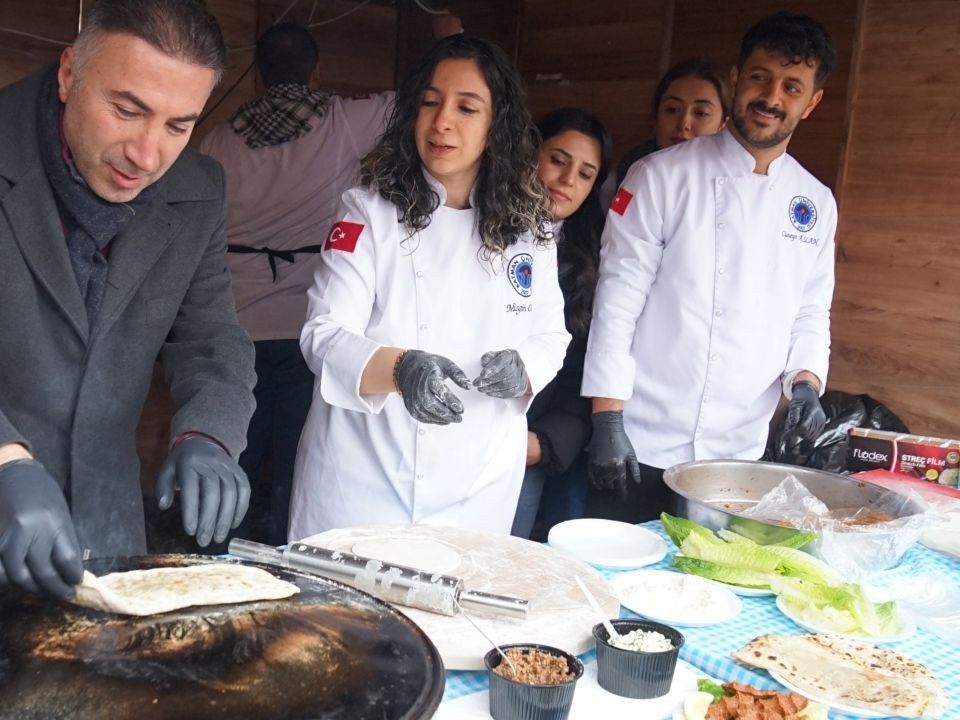
Şam böreği being prepared at a Batman University festival
Local dishes of Batman
- AYRAN SOUP (MEHİR)
- İÇLİ KÖFTE (KÜTÜLK)
- STUFFED TRIPE (UR U ROVİ)
- STUFFED RIBS (KABURGA DOLMASI)
- DRIED STUFFED VEGETABLES (KURU DOLMA)
- MIXED VEGETABLE STEW (TIRŞIK)
- BAĞISAK DOLMASI
- ÇİĞ KÖFTE
- PERDE PİLAV
- LENTIL SOUP
- YAYLA SOUP
- TANDIR BREAD
- ŞAM BÖREĞİ

Places to visit in Batman
The Ancient City of Hasankeyf

Visitor note: Since the Ilısu Dam began holding water, most of old Hasankeyf has been under the reservoir (since 2020). The Zeynel Bey Tomb, the Artuqid Bath, the Er-Rızk Mosque, the minaret of the Süleyman Han Mosque, the Kızlar Mosque, the İmam Abdullah Tomb and Zaviye and the castle’s Middle Gate have been moved to the Cultural Park Area in new Hasankeyf, about 3 km from the old town. Of the Koç Mosque, only architectural elements such as its portal and mihrab were relocated. The two baldachin tombs in the park are new buildings, built to house relocated graves. The Hasankeyf Museum also stands in the park. The castle rock remains above the lake and can be seen on boat tours of the reservoir. Check the current situation with the Batman Provincial Directorate of Culture and Tourism before visiting the places below.
It is not known exactly when Hasankeyf was founded. The city's geopolitical setting strengthens the likelihood that it is a very old settlement. The many caves, some of which are still used as homes from time to time even today, show that people settled here in very early times.
According to the available information, the founding of Hasankeyf Castle dates to the 4th century AD. In the middle of that century, the Byzantine emperor Constantine, who had taken the area around Diyarbakır, had two border castles built to protect the region. One of these two castles is Hasankeyf Castle.
When the castle gained political importance against the Sasanians, it was refortified more strongly. Hasankeyf was conquered by the Umayyads in AD 639. After this, the Abbasids, Hamdanids, Marwanids, Artuqids, Ayyubids and Ottomans ruled it. Hasankeyf enjoyed its most brilliant period under the Artuqids. Many historic monuments from this period survive in the centre.
Memikan Bridge

Although there is no certain information about when it was built, comparing it with the stone bridges in the area at Hasankeyf, Malabadi and Cizre, it is clear from the stone materials used in its construction that the bridge closely resembles them. However, it may also have been built after the Muslims took control of the region in the 6th century. Or it may have been built on the ruins of a bridge from antiquity.
The Memikan Bridge, which once carried the trade of the settlements on the Garzan Plain in Batman's Beşiri district, especially with Hasankeyf, stands at a strategic point where it linked the Silk Road passing through this region across the otherwise impassable Garzan Stream. The Memikan Bridge, on this strategic road, a busy caravan route from antiquity to the first half of the Middle Ages that ran parallel to the Garzan Stream and served for many years in providing access to Northern Mesopotamia via Hasankeyf and especially in trade between the beyliks, is now in ruins.
We say the Memikan Bridge must be included in a trip to Batman, home to hidden remains. Let us give a little information about the history of the Memikan Bridge…
It is not known for certain in which year or by whom the Memikan Bridge was built. It resembles the Malabadi Bridge, also in the same city, architecturally. The fact that it was built at a strategically important point shows that the bridge was very important in its time.
Malabadi Bridge

According to Evliya Çelebi, this bridge is an architectural masterpiece of the Abbasid period. The Seyahatname tells that a wealthy merchant of the Abbasid dynasty had the bridge built as a charitable work. It is also said, however, to date from the Artuqid Beylik and to have been built in 1147 by Timurtaş, son of İlgazi, one of Artuk's grandsons. It is regarded as the twin of the Mostar Bridge. This single-arched bridge can be entered from two ways. Rooms were built inside it for people to rest, sleep and shelter from outside dangers. This marvel of engineering, which besides carrying traffic had many functions, must certainly be seen by enthusiasts, like Batman's other monuments.
The Malabadi Bridge is also described in Evliya Çelebi's travel book, the Seyahatname. The bridge is seen as the twin of the Mostar Bridge.
The Malabadi Bridge, 20 kilometres from the Silvan district of Diyarbakır and on the Batman River, is a monument history lovers can visit. Among the other historic works that should be included in a trip to Batman are the Memikan Bridge and the Ten-Arched DDY Bridge.
Ten-Arched Bridge
This bridge, completed in 1944, which brought the State Railways to Batman in that year, is an architectural marvel of its time. Built on the Batman River 7 km from Batman city centre, with ten arches, the bridge was designed to carry not only trains but also people and animals. Another special feature of this bridge is that it was built between 1939 and 1944, while the Second World War was raging in full force. It is proof that the government of the Republic of Türkiye, which did not take part in the war, was striving with all its might in those years for the country's development and construction.
Hızır Bey Mosque

The Hızır Bey Mosque, in the centre of Batman's Kozluk district, is the largest mosque in the district. Its surviving inscription states that it was built in AD 1512 by Hızır Bey, son of Ebubekir Roşki, Bey of Sason and Hezo (Kozluk).
The mosque was built in 1512 by Hızır Bey, son of Ebubekir Roşki, Bey of Sason and Hezo. It takes its name from its founder. Information on who built it and when is in the mosque's inscription.
You could plan a trip soon to discover Batman's historic beauties, hidden for centuries. When you draw up your list of places to see in Batman, we recommend that you be sure to include the Hızır Bey Mosque, the Malabadi Bridge and the Ten-Arched DDY Bridge.
İbrahim Bey Mosque

According to the inscription over the entrance of this mosque in the centre of Batman's Kozluk district, the mosque was built in 1705 by İbrahim Bey, son of Murtaza Bey of the Garzan tribe. The mosque's minaret was built on a five-sided base, and its architecture has great artistic value and fine elegance. The minaret was also built with a double stairway: one has 100 steps and the other 99.
The mosque's inscription has survived to this day. The minaret of the mosque, whose architecture is still sound today, stands on a five-sided base. The minaret is a great work of art. One of its features is that it has two stairways: one with 100 steps and the other with 99.
Mor Kiryakus Monastery

The region whose boundaries in antiquity ran from the south bank of the Tigris to the Syrian border, and which in church administration belonged to the bishopric in Hasankeyf, is called Tur Abdin. The Mor Kiryakus Monastery, at the far edge of the Tur Abdin region held sacred by Syriac Christians, holds an important place among the nearly 80 churches and monasteries in this region. There are two stone inscriptions in Syriac, one over the main entrance to the monastery and one over the arched door that divides the inner courtyard in two. The first mentions a man named Salibo of Aleppo but gives no information on when the monastery was built. This is because Syriac Christians always preferred the inscriptions in the monasteries and churches they built to be religious hymns carrying messages to people from the Gospel, rather than documents giving dates. Both inscriptions in this monastery are hymns.
The missionary monks who came from Aleppo to the Tur Abdin region in the 4th century, baptising people and converting them to Christianity, made it a tradition to found monasteries especially on hills and crags overlooking the Northern Mesopotamian plain. The Mor Kiryakus Monastery, built on the eastern slope of Mount Kıra facing the Northern Mesopotamian plain, is a product of this idea. It is also very important as one of the first monasteries in the region and for paving the way for new monasteries after it was built. For the monks, who were the pioneers of missionary work in the countryside in those days, believed that they could succeed in spreading Christianity only through the monasteries and churches they built in this way.
Accordingly, it is very likely that the Mor Kiryakus Monastery was built in the 4th century, the interregnum period of early Christianity, around AD 457. For there was no tradition of building bell towers in churches and monasteries built in the 4th century. The absence of a bell tower at the Mor Kiryakus Monastery confirms the date of construction given above. For the building of bell towers in monasteries and churches became a tradition in the following century, inspired by the minarets added to places of worship with the rise of Islam.
The repairs and renovations carried out by the state on monasteries and churches in many places within the Empire's borders, which have come down from the Ottoman period to the present thanks to the tolerance shown to minorities, can also be seen at the Mor Kiryakus Monastery. The Mor Kiryakus Monastery was repaired several times by the state up to the end of the 17th century, and it is said that the upper floor was added at that time. During these repairs, stonemasons were brought from Hasankeyf to work on the Mor Kiryakus Monastery. Because the mysterious monasteries and churches of unique architectural beauty scattered across the rugged landscape of the Tur Abdin region, including the Mor Kiryakus Monastery, no longer have congregations, many of them have been abandoned. However, all these abandoned monuments, each a monument in its own right, have been registered and placed under protection by the Ministry of Culture.
The Mor Kiryakus Monastery, in the village of Ayrancı in our province's Beşiri district, is also one of our registered buildings. Built on an area of about 2.5 dönüm (2,500 m²), the Mor Kiryakus Monastery is a 3-storey building, with an underground floor that extends below ground through tunnels. It is rectangular in plan outside; inside there is a large enclosed courtyard of two square plans, with rooms behind arched buttresses around it.
The architecture of the eight-sliced stone dome and the star-shaped crosses forming the ceiling of the room used as the bedroom of the Monastery's Patriarch is of particular artistic value. The presence of many adjoining rooms of different sizes in the Mor Kiryakus Monastery, much of which is in ruins, shows that it was a complex made up of a place of worship, a school and a place of retreat. It is known that the priests who completed their education in this complex and received the title of priest were appointed as teachers to the other churches in the Tur Abdin region.
It was active until the early 1940s, but after that its last congregation left the monastery and no Christians remained here. However, the monastery's valuable works, among them a round fan with a rattle-shaped rim mounted on a staff and depicting an angel's face, the monastery bell weighing about 100 kg, and many manuscript books and Gospels, were taken to the Mor Gabriel Monastery in Midyat and placed under protection.
Its interior has as many unusual details as its exterior architecture. The Mor Kiryakus Monastery will be an impressive visit on your Batman trip.
Mor Aho Monastery

The Mor Aho Monastery, thought to have been built during the rule of the early Syriacs in Hasankeyf, was built in the Banı Mahar countryside, 2 km north of the village of Üç Yol in the Hasankeyf district of Batman province. The monastery's local name among the people is Deyr Mahar, meaning the Mahar Church.
There is no certain information about when the Mor Aho Monastery, built on a flat area about 150 metres above the Tigris and overlooking it, was built. No inscription giving its date of construction was found during an examination of the monastery. Like the other monasteries in the countryside and settlements of this region, this ruined monastery, 10 km east of the Hasankeyf district centre, was left to itself when its congregation left the region over time, and as a result of heavy damage by the climate and the elements, parts of the building have collapsed and its walls have fallen. There is no trace of its having been destroyed or damaged by human hands.
It was built on a rectangular plan on an area of 600 m², about 20 × 30 metres. Apart from farmland, there are no other buildings around it. However, on the bank of the Tigris there is a garden full of fruit trees thought to have belonged to the monastery. The ruined historic structures in this garden are strong evidence confirming that the garden belonged to the monastery. Locally this garden is called the Attafiye gardens.
Cut stone, rubble stone and ces (slaked lime) were used as local materials in building the Mor Aho Monastery. There is also a water well in the monastery garden. Because it has had no congregation for centuries, it has fallen into ruin through neglect. The Attafiye garden on the bank of the Tigris is likewise abandoned. This monastery has also been registered and placed under protection by the Ministry of Culture.
It is not known for certain in which period or by whom the monastery, in the area called the Banı Mahar countryside, was built. The monastery has no inscription. Rubble stone, local cut stone and slaked lime were used in building the Mor Aho Monastery. The monastery, 10 km from the district it belongs to, was never used again after its congregation left the region.
Although it is in ruins today, it is one of the foremost places that should be included in a trip to Batman. Like the Mor Aho Monastery, the Mor Kiryakus Monastery is also a building worth visiting for its long history.
Bozikan Castle

It is in the village of Kaleyolu (Bozikân), 25 km north of the Sason district. This Byzantine castle, like the other castles, is one of the structures of the 4th century, and it is said to have had the task of controlling this section of the Silk Road, which linked east and west.
There is information that the castle was built in the Byzantine period, and like the other castles in the region it was built in the 4th century. According to estimates, it was built to control the Silk Road passing through this region. Bozikan Castle, 25 kilometres from Sason in Batman, awaits new visitors with its remains, which bear witness to a long history.
Hasankeyf Castle

Hasankeyf Castle, made of a single mass of rock, stands on the bank of the Tigris, 200 m above the river. It was built by the Byzantines in AD 363 as the seat of a Syriac bishopric. After Christianity spread in this region, a decision taken by the Council of Chalcedon in AD 451 gave the bishopric in Hasankeyf the title of Cardinal. This castle, very well protected and hard to capture, is the strongest castle the Byzantines built in the east. The original name of Hasankeyf Castle is "Hısno Koyfa", that is, the Rock Castle.
Hasankeyf Castle, which served a religious function during about 300 years of Byzantine rule, was conquered after the rise of Islam, following the rule of the Abbasids, Marwanids and Hamdanids in turn, in 638 by Iyad ibn Ghanm, commander of Khalid ibn al-Walid. After the Battle of Malazgirt in 1071, with the Seljuks entering Anatolia, Hasankeyf Castle fell within the borders of the Artuqid Beylik, which ruled this region; the Artuqids rebuilt it, opened it to settlement and made it the capital of the Artuqid Beylik between 1101 and 1231. When Hasankeyf was invaded by the Mongols in 1260, the people left the city and took refuge in the very strong castle and the caves on the slopes, and so managed to escape Hülagü's cruelty, at least in part.
Hasankeyf Castle has two gates. The eastern gate is called the İmam Abdullah Gate and the western gate the Sır (Secret) Gate. The castle is reached by these stepped paths. There are many inscriptions on the castle walls. Two supporting paths, one open and one hidden, were built down to the Tigris to carry water to the castle. These stepped paths, with 200 steps each, are still in good condition. There are also many inscriptions. This historic castle of Batman is more famous than the city's other castles.
Hallan Çemi Mound
This mound on the bank of the Batman River, within the village of Kaletepe in Batman's Kozluk district, dates from the Neolithic period and has a history of 10,000 years. It is one of the foremost places where humanity made the transition to settled life. The finds from archaeological excavations here show that people first took up farming and obtained lentils and peas by sowing wild seeds.
Hallan Çemi Mound was first noticed in 1990. Michael Rosenberg and H. Togul, researching in the area, came across decorated stone vessels during surface surveys here. Archaeological work was then started by the Diyarbakır Museum. The excavations showed that the site went through three building phases.
Hallan Çemi Mound, a valuable part of Batman for tourism, is a place that must be explored. It will be an impressive trip for history lovers.
Yol Geçen Hanı, Hasankeyf

As is well known, there is a famous saying in our culture: "YOLGEÇEN HANI" (the inn everyone passes through). This witty expression, which we use to one another at many moments of our lives, in fact also expresses a truth. For the han in the story "Is this the Yol Geçen Hanı?", the origin of this expression used for places where no one knows who comes and goes, is in Hasankeyf, the ancient city of Batman province. This natural cave, known among the people for centuries as YOLGEÇEN HANI and able to hold about a thousand people, lies beneath Hasankeyf Castle, made of a single mass of rock, and its mouth opens towards the Tigris. Inside this natural cave there is a cellar for storing water and a secret path up to the castle.
In the days when transport was by waterways, people waiting their turn for the rafts and keleks (inflated-skin rafts) that took them to and from the far bank of the Tigris rested in this dim and exotic place, and those caught by nightfall slept here until morning; the air flow inside it suits the human body. This atmosphere in the cave, cool in summer and mild in winter, still keeps the same quality today and draws people to rest. This is why, for thousands of years, this cave, where no one knows the religion, language or race of those who come and go, but which always sees heavy human traffic, has been called YOLGEÇEN HANI, and it has become an indispensable and exceptional place in life in Hasankeyf. Whoever gave the name YOLGEÇEN HANI to this natural cave, known as a han in every period and used by people to rest, added an unforgettable link to the chain of sayings that hold an important place in our social and cultural life.
The fact that the reality of YOLGEÇEN HANI, witty and full of subtle humour, has long been in Hasankeyf makes it a regular stop for smiling, cheerful people who long for nostalgia and look to the future with hope. The cave lies on the lower bank of the Tigris, in the area now under the Ilısu Dam reservoir.
In the Yol Geçen Hanı there is a secret passage leading up to Hasankeyf Castle. In earlier times this cave was used for transport. The inside of the cave is cool in summer and mild in winter. For this reason it suits the human body very well. This cave, which was a route of passage and where no one knows who comes and goes, was named Yol Geçen Hanı.
Because of the reservoir, the Yol Geçen Hanı can no longer be visited.
Hasankeyf Ruins

Thanks to the limestone terrain that surrounds the Hasankeyf ruins on the south and south-east, deep and imposing canyons lined with cave dwellings form a magnificent landscape, as if nature and people had worked hand in hand here on a shared project. This area, with more than four thousand caves, is a natural wonder with few equals in the world. You never tire of watching the landforms shaped by the narrow valleys formed over the thousands of years in which the Tigris has meandered, by the deep hollows where floodwaters run down the slopes into the Tigris, and by the rugged terrain that results.
Hasankeyf draws the interest of foreign tourists as much as Turkish ones. You can take an enjoyable trip, steeped in history, among rare natural formations and the homes people made in this landscape.
The Hasankeyf ruins, which lay humanity's past before your eyes, still bear the traces of a different period in every corner.
El Rızk Mosque
The El Rızk Mosque, next to the Ten-Arched DDY Bridge on the Tigris, is one of the buildings that have survived from a very early period.
Although much of the mosque has collapsed, its finely worked minaret still stands firm beside the Tigris. The El Rızk Mosque is one of the symbols of Hasankeyf. Although its inscription states that it was built in 1409, the year of construction is not known for certain. The mosque's founder was the Ayyubid Sultan Süleyman.
Because of the reservoir, the El Rızk Mosque was moved in 2019 from its original site to the Cultural Park Area in new Hasankeyf, where it can be seen today.
Caves of Hasankeyf
The caves of Hasankeyf have kept their solidity since very early times. Hasankeyf, a very old human settlement, today also offers an impressive journey through history with its caves.
Used as shelter and dwellings since the dark ages of history, or since people adapted to settled life, these caves in Hasankeyf have come down to the present day without losing anything of their form and have kept their many functions in every period. These caves, about 4,000 in number, sheltered the Sumerians, Assyrians and Babylonians, the cave-age inhabitants who ruled in Northern Mesopotamia many years before Christ.
Clean water was brought to these caves, which formed a settlement in their own right and were the centre of many civilisations through history, from the rocks opposite by a siphon-like system based on the principle of communicating vessels, through clay pipes laid on flat ground and channels cut into the rock, and then across a valley 200 metres deep. Many water systems that inspired the laws of physics can always be seen within Hasankeyf's water civilisation.
The caves of Hasankeyf have managed to stay in use in every period. They were used as shelters by the Sumerians, Assyrians and Babylonians. The caves used as dwellings were formed with channels carved into the rock. There are about 4,000 caves in the area. Many of the caves are now under the reservoir; the cliffs and caves above the water can be seen on boat tours.
Zeynel Bey Kümbet
The Zeynel Bey Kümbet, which has survived from the years 1460–1486, is regarded as the first example of monumental tombs in Anatolia. It was built for Zeynel Bey, son of the Akkoyunlu ruler Uzun Hasan, and is a monumental tomb from the Akkoyunlu period (1460–1487). The inscription over the north door of the Zeynel Bey Kümbet, the first example of the monumental-tomb tradition in Anatolia, states that it "was built for Zeynel Bey, son of Bahadır Han Hasan Bey, who fell as a martyr at the Battle of Otlukbeli on 11 August 1473". Above the circular burial chamber, the main body rises, circular outside and octagonal inside. Its ceiling is domed and covered with a conical roof. The words "Allah – Muhammad – Ali" written in tiles in 3 rows, one above the other, around the outside of the body give the kümbet's architecture a special aesthetic. This cylindrical building, unique of its kind, draws attention with its tile inscriptions and its building inscription. The architect was a man named Pir Hasan, son of Abdurrahman.
Zeynel Bey was the son of Uzun Hasan, the Akkoyunlu ruler. The tomb in which Zeynel Bey is buried has unique stonework. The kümbet has a cylindrical form, with tiles used around its body. It is covered with a conical roof.
According to the inscription on the Zeynel Bey Tomb, it was built for Zeynel Bey, who fell as a martyr during the Battle of Otlukbeli on 11 August 1473.
In 2017 the Zeynel Bey Kümbet was moved from its original site by the Tigris to the Cultural Park Area in new Hasankeyf. It is one of the places to visit for its architecture and its religious importance.
İmam Abdullah Zaviye
The İmam Abdullah Zaviye used to stand on the hill to the left at the entrance to the Hasankeyf Bridge, in the middle of a cluster of graves overlooking the Tigris from the north; today it is in the Cultural Park Area in new Hasankeyf. In AD 638, in the last Islamic raids organised to free Hasankeyf Castle from six hundred years of Byzantine rule, İmam Abdullah served as the right-hand man of Iyad ibn Ghanm, the famous commander of Khalid ibn al-Walid, and fell as a martyr during the siege of Hasankeyf at that time.
İmam Abdullah, son of Ja'far al-Tayyar, the cousin of the Prophet Muhammad, is a revered man descended from the Prophet's family and an exceptional saint. For this reason his tomb has been respected as a zaviye in every period and, repaired many times from the Ayyubid period to the late Ottoman period, has survived to the present day with little damage.
The tomb of İmam Abdullah, built on a square plan inside a rectangular courtyard, has a tower, also on a square plan, at its right corner, and a long rectangular masjid to the south of the tomb. The fine wood carving of the door leaves of the barrel-vaulted entrance between the tomb and the tower, and the finial on the tomb's dome, show the characteristics of 14th-century taste. This door, of great artistic value, is preserved in the Diyarbakır Museum. The İmam Abdullah Zaviye, registered by the Ministry of Culture, is commemorated every year in the first week of June by the people of Hasankeyf and the surrounding villages, and throughout the week vows are made and wishes offered around the tomb.
The İmam Abdullah Zaviye is one of the places that should be on Batman's list of sights. The man buried in the zaviye is known to be the son of Ja'far al-Tayyar, the cousin of the Prophet Muhammad (pbuh).
The İmam Abdullah Zaviye used to stand on the hill to the left of the entrance to the Hasankeyf Bridge, north of the Tigris; it has now been moved to the Cultural Park Area in new Hasankeyf. The zaviye was built on a square plan. Its courtyard is rectangular. There is also a masjid next to the tomb.
The İmam Abdullah Zaviye is visited by large numbers of villagers every June. In the first week of June, vows are made and wishes offered.
Tomb of Seyyid Bilal
The Tomb of Seyyid Bilal is one of the places in Batman where history and a religious atmosphere come together.
The Tomb of Seyyid Bilal, in the village of Vergili (Becirman) in the Gercüş district, is the busiest centre of faith tourism in the Southeastern Anatolia Region. There is good reason why the village of Vergili (Becirman), known throughout Türkiye as a village of seyyids, became famous through the name of Seyyid Bilal: it is home to an exceptional figure of the Ahl al-Bayt line such as Seyyid Bilal, known to be descended from Hüseyin, grandson of the Prophet Muhammad.
Seyyid Bilal, who according to the inscription in his tomb lived between 1132 and 1212, spent part of his life in the Karbala region of Iraq; in 1154 he moved from Baghdad to the village of Vergili (Becirman) in the sanjak of Hasankeyf, spent the rest of his life there and died there. Seyyid Bilal was respected by the rulers of every period from the beginning of the Beylik period to the last years of the Ottoman sultanate, and because of the unity and solidarity he brought about through the messages of peace, brotherhood and love he spread among the people, Sultan Abdülhamid exempted the village of Vergili (Becirman), where he is buried, from taxes.
The village of Vergili (Becirman), known in our region as the village of seyyids and regarded as sacred because it is home to the Tomb of Seyyid Bilal, is also famous for its historic fabric. Around the village there are many caves, historic hans and watermills. Every year in the second week of September, days of commemoration for Seyyid Bilal are held in the village. During these days people flock to Becirman from every corner of the country.
The Tomb of Seyyid Bilal, which has an important place in faith tourism, is often visited by local people and draws great interest from tourists from other cities. Seyyid Bilal is known to be descended from Hüseyin, grandson of the Prophet Muhammad (pbuh). For this reason it is visited constantly.
The tomb, in Vergili village in Batman's Gercüş district, is very easy to reach… The Tomb of Seyyid Bilal, which holds a place in the city's mystical atmosphere, is one of the important places that should be on your list of sights.
Kozluk Castle
This castle, one of the important castles of the Erzen region in the triangle between Hasankeyf, Siirt and Maiferkeyn (Silvan), was built on a rocky hill in AD 416 as a religious centre for the Persian dynasty. Over time, however, it came to control all traffic as an important base on the Silk Road that passed through this region in the Middle Ages. Kozluk Castle, which remained under the Iranian Empire for many years, was the seat of a Nestorian bishopric in the 5th century when it was taken in AD 639 by the Muslim armies under Iyad ibn Ghanm. The castle, in a very ruined state, is in the Kale neighbourhood of the Kozluk district centre.
If you are interested in historic buildings and most of your trips are a step into history, you should be sure to visit Batman's hidden treasures.
Kozluk Castle in Batman has kept its solidity compared with the city's other castles. The building, thought to have been built in AD 416, stands on a rocky hill in the Kale neighbourhood. Another name for Kozluk Castle is Hezo Castle.
The castle remained under the Iranian Empire for many years. It later came under the protection of a Nestorian bishopric and of the Muslim armies.
Rabat Castle
Rabat Castle, where work has recently been done to open it to tourism, is a building that sheds light on Batman's history and held a very important place in the past.
The wars between the Persians and the Byzantines over the division of the Erzen region, which began at the start of the 4th century, went on until the end of the century. In this period the Byzantines built many defensive castles in the triangle of Sason, Kozluk and Bitlis to fend off counter-attacks. Rabat Castle, in the village of Yanıkkaya (Rabat), 18 km north of the Kozluk district, is one of them.
The castle in Rabat village, in the Kozluk district, is thought to have been built in the 4th century. Serving as a guard post for 2,000 years, it was one of the strongest and best-protected castles of its time.
Work is currently being done to open the castle to tourism again. By visiting Rabat Castle on your Batman trip, you could be among the first to discover this historic building.
Among the city's castles are also Beksi Castle, Kandil Castle and Hasankeyf Castle.
Kandil Castle
Kandil Castle in Batman held an important place when it was built. Like Beksi Castle in the same district, Kandil Castle was built by the Byzantines.
This castle, built on a hill south of the village of Bölükkonak (Hergemo) on the old road to Sason, 6 km north-west of the Kozluk district, was built by the Byzantines in the first quarter of the 4th century to strengthen the castles in the east and to prevent outside forces from entering the Erzen region.
The castle, 6 kilometres from Kozluk, was built south of the village of Bölükkonak. Kandil Castle, dating back to the 4th century, is among the buildings that shed light on Batman's history. Batman's other castles are Rabat Castle, Bozikan Castle and Hasankeyf Castle.
Beksi Castle
Beksi Castle is one of Batman's historic treasures. The castle, which has come down to us in ruins, is near the village of Bekiş, 7 kilometres from the Sason district.
It stands on the southern slope of Mount Meydanok, 7 km north-west of the Sason district. The fact that this partly ruined castle near Bekiş village was built by the Byzantines on the slope of a mountain overlooking the valley, with a strong defensive strategy in mind, shows that it was never captured in any period, because it has terrain that is very hard to take.
Beksi Castle, thought to have been built by the Byzantines, stands on the slope of a mountain overlooking the valley. This is a sign that the castle was never taken by another civilisation in any period. Apart from this, there is not much information about the castle.
Pertükan Castle
This castle, east of the village of Tekevler (Gündenu), 4 km south-west of Sason, is in a very ruined state. Because it is easy to reach, it appears to have changed hands many times in conflicts through history. The collapses here and there in the castle walls and the large breaches opened in them show that the castle was a focal point in wars.
With its mosques, churches, monasteries and bridges, Batman lays bare the deepest traces of history. Although not many people know it, it has many important historic works.
If you are planning to travel to Batman soon, don't miss the chance to see the city's historic fabric up close. On this page we will tell you about Pertükan Castle, one of the buildings that shed light on the city's history.
Pertükan Castle, 4 kilometres from the Sason district, is ruined today. The castle held an important place in history.
The castle is very easy to reach. It lies just east of Tekevler village. Although there is not much information about Pertükan Castle, and although it is in ruins, it is an important work that tells, through the collapses in its walls, that it witnessed important events in history.
Source: https://www.gezilebilecekyerler.com/batmanda-gezilecek-yerler/
Culture and arts in Batman
Traditions and customs
SEEING AND ASKING FOR A BRIDE:
Marriages take place both by arrangement (görücü usulü) and through young people seeing and getting to know each other. To describe the arranged way: the young man's side goes to the girl's house as "görücü" (viewers). They assess the girl as they drink the coffee she serves. If they want to see her again, they ask for water. An elderly woman representing the young man's side looks over the build of the prospective bride as she brings the water. They study how she walks, test her hearing by calling to her softly and, when leaving, kiss her to find out whether she has bad breath.
As the viewers leave the girl's house, they decide among themselves for whom they will ask for the girl they liked, and ask her relatives whether she would be given if asked for. The young man's side, sometimes through a go-between, asks whether they may come to the girl's family's home to drink tea and ask for her hand, and asks them to set a day. The girl's side asks for time to make the necessary enquiries, saying "We will also think about it within the family." If the girl's side approves the request, they tell the young man's go-between the day on which they will be received for tea. This confirms that the girl will be given.
The young man's side goes to the girl's house with the imam in a group of several people. The girl is asked for and the promise is made. After this the engagement and the wedding take place. In our province weddings usually begin on Thursdays and Saturdays and continue on the following days. At weddings the drum, zurna, tef, kemençe and kaval are played.
BRIDE PRICE (BAŞLIK PARASI):
In our community, which is developing fast and changing accordingly, new values can be seen taking the place of old customs. The bride price, a social wound in our society, has partly disappeared. In the city and district centres, especially among educated families, this custom has been abandoned. The bride-price tradition, which keeps its character in the villages, continues in the form of the girl's side, having received the bride price, adding to it and preparing a trousseau for the bride.
FUNERALS:
After the funeral, condolences are received for three days. In villages this period is even longer. The relatives of the deceased do not go to work during this time. They receive those who come from round about to offer condolences. Those who come to the house of the deceased to offer condolences (taziye) bring gifts according to their means, such as tea, sugar, flour and cooking fat. This is done in the provincial centre. Those who come to offer condolences recite a sura of the Qur'an or the Fatiha. They pray for mercy and forgiveness for the deceased. Guests who come to the house are served tea and food.
CIRCUMCISION:
Circumcision, a religious duty, begins with festivities held according to the family's means. First the boy to be circumcised is driven around the city with his friends. He is dressed in circumcision clothes. Before the circumcision, a mevlit is recited at home. Then a meal is given to the guests. The boy is circumcised on the lap of the chosen kirve (sponsor). The kirve is valued like a relative for life and counted as one of the family.
Source: http://www.batmankulturturizm.gov.tr/TR,56591/gelenek-ve-gorenekler.html
History of Batman
The earliest information about Batman's history is given in folk tales, myths and Herodotus's history. According to the common accounts, Cyrus, grandson of the MEDIAN king Abtyagestin, when his opponent Erpagazso was defeated in 550 BC, had to withdraw, out of shame among the MEDIAN nobles, to their lands at the north-western tip of Media, where the MEDES lived. According to another view, Cyrus settled in this area so as not to remain under Persian rule. An artificial islet was made in the middle of this area of hawthorn, reeds and marsh, and it was named "ELEKHAN", meaning "khan's camp" (546 BC). ELEKHAN spent 194 independent and happy years before being invaded by Alexander the Great in 352. It then came under the rule of the Lesepkos, the Parthians, the Romans, the Sasanians and Byzantium. It passed to the Artuqids, the Mongols, the Ilkhanids, the Jalayirids, the Karakoyunlu (Pezrese), the Akkoyunlu and, in 1500, the Safavids.
In 1515, during the Baghdad campaign of Murad IV, he gave the whole area between the Batman and Botan rivers, including ELEKHAN, to Mahmut Pasha, son of Turhan, who had served him with great distinction. After this, ELEKHAN changed in pronunciation and became ELAH in popular speech and, over time, "ILUH". İluh was recorded as a village and kept its identity as part of the Elmedin kaza of Siirt province.
The settlement of Elmedine was wiped off the map in the spring of 1926–27 when today's Batman River flooded, and İluh village was attached to the Beşiri (Kobin) district. There is no settled view of where the name Batman comes from; according to one view, the name of today's Batman River was given to İluh village in the early 1950s. According to the common view, the name Batman was given when the first test tower was set up below İluh village, from looking at the area where TPAO's facilities stood.
İluh, made a bucak (sub-district) in 1937, saw great development in every field as the oil deposits in the region were exploited in the late 1940s and early 1950s. Following these developments, it was recognised as a district on 2 September 1957.
With İluh's population recorded as 4,713 in the 1955 general census, a municipality was set up on 2 November 1955. Batman, which grew very rapidly up to 1990, became Türkiye's 72nd province by Law No. 3647 of 16 May 1990.
Source: http://www.batmanda.com/batman
Getting to Batman
Batman has a regular transport system by air, road and rail. From central Batman, which lies at the junction of roads coming from the east, west and north, there are bus services to every province in Türkiye around the clock. The Haydarpaşa–Kurtalan railway line also passes through central Batman. Those who like train travel or have a lot of luggage can choose to travel by rail. For those who want to fly, there are direct flights every day from Ankara and Istanbul, and connecting flights from many cities such as Antalya, İzmir and Adana. THY's scheduled flights fly every day from Batman airport to Ankara and Istanbul.
Those who want to drive must be prepared for a very long journey. Those setting out from Istanbul should follow the Istanbul–Sakarya–Ankara–Aksaray–Adana–Gaziantep–Şanlıurfa–Diyarbakır–Batman road. Those coming from İzmir should follow the İzmir–Afyonkarahisar–Konya–Adana–Gaziantep–Şanlıurfa–Diyarbakır–Batman road. Those leaving from Ankara should choose the Ankara–Kayseri–Malatya–Diyarbakır road. Those wanting to go from the Trabzon side should use the Trabzon–Bayburt–Bingöl–Batman route.
* Istanbul–Batman: 1,543 km, about 16 hours.
* İzmir–Batman: 1,540 km, about 17 hours.
* Ankara–Batman: 1,010 km, about 1 hour.
* Antalya–Batman: 1,219 km, about 14 hours.
* Trabzon–Batman: 591 km, about 9.5 hours.
Districts of Batman
- Beşiri
- Gercüş
- Hasankeyf
- Kozluk
- Merkez (central district)
- Sason
Economy of Batman
Batman's economy rests largely on oil extracted from Mount Raman. Part of the oil is carried by the Batman–İskenderun pipeline to the Yumurtalık area. The refinery is the only large industrial plant in the city.
Besides the refinery there are small, mostly private businesses such as brickworks, feed mills, lentil processing, cotton ginning and biscuit making.
Farming is concentrated on the Batman and Beşiri plains. The Batman Plain is counted among Türkiye's fertile plains; with irrigation, cotton, tobacco, wheat, pulses, fruit and vegetables are grown. Cattle rearing is widespread in the mountainous parts.


Comments
Loading comments…