
Karaman
- Central Anatolia Region
About Karaman
Karaman, in Central Anatolia, covers an area of 8,924 square kilometres. It is bordered by Konya to the west and north, Mersin to the south and Antalya to the south-west. Sharing the basic climate of Central Anatolia, Karaman has a continental climate with hot, dry summers and cold, snowy winters. Like everywhere in Turkey, it has been home to many civilisations. Although the date of Karaman's founding is not known, archaeological excavations have found evidence that it was an important settlement and a centre of trade and culture. In Hittite times the province was a military district and trading centre; it later came under the rule of the Phrygians and Lydians, and in 322 BC it was occupied and plundered by the Greek King Perdikkos and Filippos. After the Anatolian Seljuk State weakened and collapsed, the Karamanids declared their independence and founded the Karamanid State here.
This city and its region, where many great Turkish figures such as Yunus Emre, Şeyh Edebalı, Kazım Karabekir, Kemal Reis, Mevlana and the poet Ayni grew up, have important tourist attractions such as caves, underground cities and centres of faith. Thirty per cent of its land is farmland, and Karaman has developed through economic activity based more on agriculture than on industry. The city has an important place in the country's production of biscuits and bulgur, sub-groups of the food manufacturing industry. About a third of Turkey's biscuit production and 20 per cent of its bulgur production come from Karaman.
Karaman's famous dishes and desserts
Karaman Province has many famous dishes, drinks, pastries and desserts of its own. But the local flavours that first come to mind when Karaman is mentioned are sulu pilav, arabaşı çorbası, köy dolması, cibe dolması, bulamaç and so on. Here are the flavours of the Karaman area…
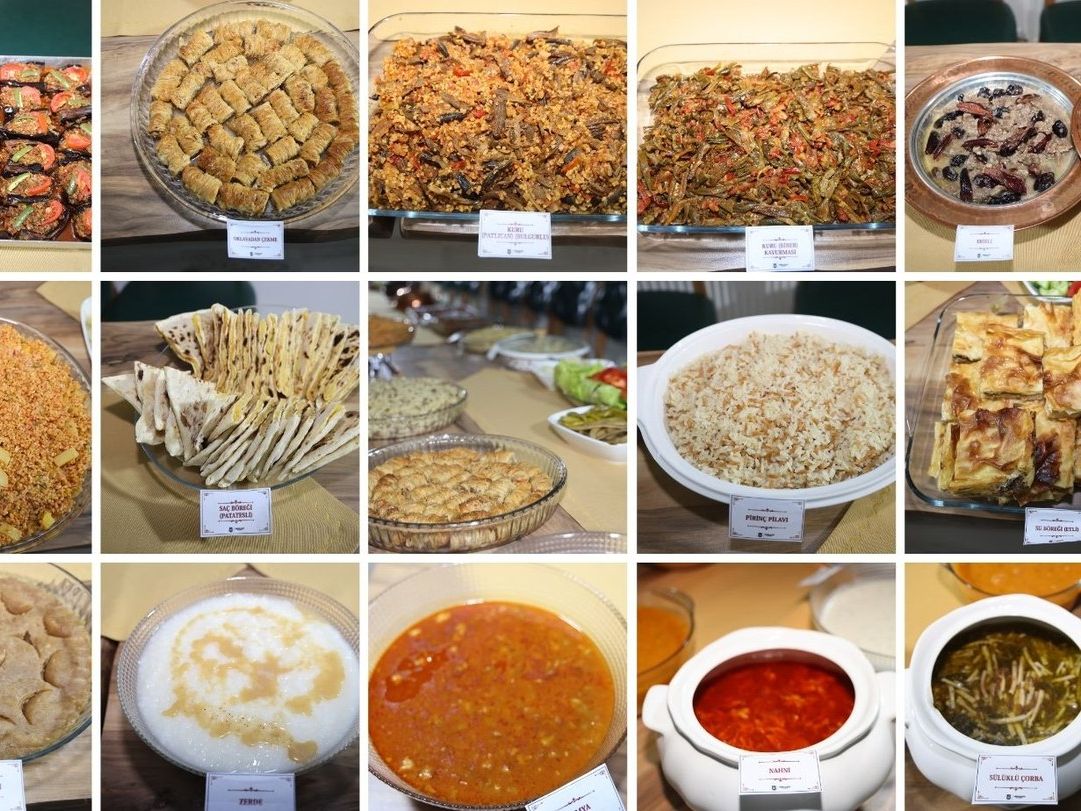
Karaman Municipality's selection of local dishes
Local dishes of Karaman
- Sulu pilav
- Arabaşı çorbası
- Köy dolması
- Cibe dolması
- Bulamaç
- Batırık
- Bidik
- Sütlü köfte
- Guymak
- Susuz kebap
- Eğey dolması
- Mıkla
- Zerde
- Toyga çorbası
- Keşkek
- Kabak çiçeği dolması
Source: http://www.nenedirvikipedi.com/yemek-tarifleri/karaman-ilinin-meshur-yoresel-yemekleri-10179.html

Places to visit in Karaman
With a history going back to the 8000s BC, Karaman is very rich in historic monuments…
Karaman Kalesi: Built in the 12th century, in the Seljuk period. It consisted of two structures, an outer castle and an inner castle, but only the inner castle has survived. Karaman Kalesi (Karaman Castle) is one of the most impressive castles in Turkey.
Ermenek Kalesi: Ermenek Kalesi (Ermenek Castle), which also contains natural caves, was used as a shelter and a dungeon. It was the first castle of the Karamanid beylik.
Mennan Kalesi: In Ermenek. Mennan Kalesi stands on a steep mountain and is built of rock. Pir Ahmet Bey took his own life by throwing himself from this castle.
Aktekke Cami: Built in the Karamanid period entirely of cut stone, it is a mosque with a large single dome and a tall minaret.
Binbir Kilise: Located 50 kilometres from the city, on the slopes of Karadağ. There are many churches here, which is how it got its name ("a thousand and one churches").
Places to visit in Karaman – historic places
Dereköy Fisandon Kilisesi

The Fisandon Kilisesi (Fisandon Church) in Dereköy, in Karaman's central district, is the only building in the city that was a church and was converted into a mosque.
It is not known in what year the church was built, but it is dated to the 9th century. In 1573–1574 it was converted into a mosque by Yusuf Sinan Paşa and became one of the places of worship of the Muslim community. The first person in history to mention the Dereköy Fisandon Kilisesi was the Byzantine art historian Strzygowski. The building stands on a rocky mound and was built on a Greek-cross plan.
It is not known for certain who built the church or in what year, because no inscription has survived. You can include the Fisandon Kilisesi in your trip to Karaman and discover a different kind of historic place.
Zeyve Pazarı

In Karaman's Ermenek district there is an unforgettably lovely stop for anyone who wants both a quiet trip in nature and enjoyable shopping: Zeyve Pazarı (Zeyve Market)…
Without going far into the centre of Ermenek, you can easily reach Zeyve Pazarı by following the signs. The area where the market is set up is full of old plane trees… Local people sell the vegetables and fruit they grow here, to tourists and locals alike, and local handicrafts are also sold. This tradition is known to have continued for a full 600 years.
Zeyve Pazarı is used as a picnic area, especially in spring and summer: it is a place where local people picnic and relax, so they spend a pleasant day while the produce is sold. The market is on the stream that separates İkizçınar village and Yayla Pazarı village.
Çeşmeli Kilise

The Çeşmeli Kilise (Church with the Fountain) is in Tapucak Mahallesi in the centre of Karaman. In official records the church is called the Surp Asdvadzadzin Armenian Church.
Dated to the Byzantine period, the church served as a prison, especially after the proclamation of the Republic, until the 1980s. In 2007 it was restored by the Ministry of Culture and reopened as a church. Although the church's frescoes had been covered up in earlier periods, they were uncovered during the latest restoration.
Today the Çeşmeli Kilise is a venue for arts events, and it is also open to visitors.
İncesu Mağarası

Every corner of Karaman offers something different to discover.
In Karaman, home to a rich culture and a long history, İncesu Mağarası (İncesu Cave), with its intriguing atmosphere, is one of the places you should see.
The cave is about 9.5 kilometres from the Taşkale township. Miocene limestone can be seen in the cave, which actually consists of two caves.
It is entirely horizontal and especially rich in dripstone. In very rainy periods a small underground river forms in İncesu Mağarası.
Exploring the cave arouses curiosity at every step and makes for an enjoyable, unforgettable trip. And we say the Taşkale Tahıl Ambarları (granaries) in the area are definitely worth seeing too.
Hürrem Dayı Evi

With its unique architecture, the Hürrem Dayı Evi (Hürrem Dayı House) is one of the most visited spots in Karaman. The mansion has an important place in tourism and carries everyone who sees it into a different atmosphere.
The Hürrem Dayı Evi is in Koçak Dede Mahallesi in the city centre. It is also counted among the finest examples of traditional Turkish house architecture. The house's wooden decoration and painted decoration are truly enchanting. It is 300 years old, and it is a pleasure that it has been so well preserved. Of course the Hürrem Dayı Evi has been through restorations, but it was repaired and renewed faithfully to the original, which has not spoiled the mansion's original structure.
Yet the owner of this impressive mansion was not a very rich man. On the contrary, it belonged to a civil servant of modest means.
Many tourists come to Karaman just to see this mansion. We say everyone should go and discover the Hürrem Dayı Evi…
Tartan Evi

Belonging to one of Karaman's long-established families, the Tartan Evi (Tartan House) has 19th-century architectural features. The two-storey house is on Tartan Sokak in Topucak Mahallesi.
Its central location makes it very easy to reach. The lower floor of the Tartan Evi was mostly used for daily life: the kitchen, pantry and ice store are on the lower floor. The upper floor has the sitting rooms and bedrooms.
The lower entrance door of the Tartan Evi was made with stones brought from Binbir Kilise.
The house's painted decoration catches the eye more than its woodwork… The rich plant motifs on its ceiling are among the finest examples of their time.
Taşkale Tahıl Ambarları

The historic granaries in the Taşkale township are one of the city's most magnificent groups of structures. The granaries are about 40 metres high.
Among the most intriguing spots in Karaman, the Taşkale granaries number 251 in total. Scattered at a great height, they vary in depth: some reach 5 metres, others 7–10 metres. The Taşkale granaries are very well suited to storing grain and pulses… In other words, they serve the same purpose as today's refrigerators.
Located in the centre of Karaman, Taşkale is a place worth seeing for its historic granaries and should definitely be on your list too.
Madenşehri Örenyeri

Madenşehri village in Karaman is a very old settlement.
Much visited today as an archaeological site, Madenşehri mostly has remains from the Byzantine period. The area has basilicas, houses and cisterns, and its most important remain is basilica no. 1 of the Binbir Kilise buildings at the entrance to the village, thought to have been built in the year 500.
Madenşehri, a small village of Karaman, is one of the places worth discovering, and we recommend that anyone whose travels take them to Karaman visit it.
Hatuniye Medresesi (Karaman)

The Hatuniye Medresesi in central Karaman dates back to 1382.
It was built by Nefise Sultan, daughter of the Ottoman Sultan Murad Hüdavendigar (Murad I). Its architect was Numan Bin Hoca Ahmet.
Although the Hatuniye Medresesi is an example of the closed-courtyard medrese type, today its courtyard is open to the sky. The medrese has a single iwan, with cells and porticoes. Its geometric inscriptions and plant motifs still catch the eye today, and its doors are also decorated with plant motifs.
The medrese, which has kept its solidity since very early in history, has been run as a restaurant in recent years.
Gökçeseki Örenyeri

Part of Karaman's rich history and also a boost to the city's tourism, the Gökçeseki archaeological site, with its necropolis, rock tombs and many historic remains, is one of the places you should definitely discover.
The site is on a hill north of Gökçeseki village in the Ermenek district. In the area you can see bowls, pots, the remains of sacred areas and plenty of rock tombs. The rock tombs are particularly striking: most have a single room, but some have several. Research has shown that the Gökçeseki site was used as a settlement in the Byzantine and Roman periods.
Taking a long trip of discovery in the area and looking at the various remains will make for a pleasant day.
Mennan Kalesi

One of the two castles of the Ermenek district, Mennan Kalesi stands on a steep hill and has been known through history as Minan and Meyan.
Known today as Mennan, the castle ruin is in a rather hard-to-reach spot, which is cited as one of the reasons it was hard to capture in the past. It is not known for certain in what year or by whom Mennan Kalesi was built; it is thought to date from the Hittite period. The castle is known to have been actively used and repaired in the Karamanid period…
After seeing Ermenek Kalesi, it is enough to go to Görmeli village and set aside just 1 hour for Mennan Kalesi.
Ermenek Kalesi

Not much is known about the history of the castle ruin built on a rocky site in Karaman's Ermenek district.
The year Ermenek Kalesi was built is not known, but it was an important castle, especially for the Karamanids. Although it takes its name from the district where it stands, it was known in the past as Firan Kalesi.
In his book the Seyahatname, Evliya Çelebi describes the castle in these words: "It is a castle made by the power of God in the middle of a red mountain that rears its head to the skies. In 32 years I travelled the lands of 18 sovereigns by land and sea, and I never saw such a castle. It must certainly be visited and seen. This castle was made by the mighty hand of God. It has no moat or towers, and in any case has no need of them. The castle is unique. It has only a small gate facing east, and even this gate is reached by a wooden staircase of 140 steps, with a wooden railing on one side. Inside the castle there are some 40–50 masonry houses. There is a soul in it. Water like the water of life springs from the rocks and flows down. In short, it is a peerless castle that one is powerless to praise enough. The castle has a dizdar (warden) and 18 soldiers."
Although the castle was generally used for defence, it is known to have been used as a prison for a time.
Karaman Kalesi
Karaman Kalesi, in the centre of Karaman and important for tourism, is dated to the late 11th century.
The castle, whose exact construction date is not known, consists of three concentric walls, of which the inner castle and the middle castle are still intact. Karaman Kalesi is known to have been repaired in the Seljuk and Ottoman periods.
Telling the story of the city's history, the castle is easy to reach because it is in the centre of Karaman, and as it is a large structure it can easily be seen from the city centre.
Manazan Mağaraları
The Manazan Mağaraları (Manazan Caves), used as an early settlement in the Byzantine period, are in Karaman's Taşkale township.
Carved into a huge mass of rock, the caves are 40 kilometres from the city centre. Seen from outside, the cave shows hundreds of holes and has five storeys. The Manazan Mağaraları have become one of the places visitors to Karaman are most curious about. You can set aside just a few hours for the caves, where traces of old life can be felt in every corner.
Meraspolis Mağarası
Do you know which cave has the largest underground water in the world? For those who don't, we'll tell you right away: the cave we mean is Meraspolis.
Meraspolis Mağarası (Meraspolis Cave) is in Ermenek, Karaman. Although it has not been well publicised so far, it has recently become one of the places explored by curious new visitors. Meraspolis Mağarası consists of several levels and chambers. It has two entrances: one is entirely natural and the second was opened later. Stalactites and stalagmites, large and small, greet visitors inside the cave.
Research has shown that this cave goes back to antiquity. Used by people in ancient times, the cave served as a dungeon as well as a shelter.
Karabaş Veli Külliyesi
There is no definite information on when the Karabaş Veli Külliyesi (Karabaş Veli Complex), built in the Karamanid period, was constructed.
The Karabaş Külliyesi, in Karaman's Siyahser Mahallesi, is divided into two parts, made up of a mosque, an imaret (soup kitchen) and a tomb. Although no inscription has survived, it is known to have been repaired in the reign of Abdülhamid II. The complex's mosque was built on a rectangular plan. The imaret is north of the mosque; it is a large building with three iwans and a central dome.
If you want to learn about other places to visit in Karaman, you can click on our pages on the Karaman Museum, the Değle archaeological site and Binbir Kilise.
Değle Ören Yeri
Bearing the traces of a different period of history, the Değle archaeological site is in Karaman. Located 35 kilometres from the city centre, the Değle site is also said to be one of the places visited by St Paul.
The site has the remains of 6 churches dated to the Byzantine period. Besides these, many inscriptions can also be seen among the historic remains. High on the slopes of Karadağ, the Değle site continues to be one of the stops for visitors to the city.
If you are planning a trip to see Karaman's little-known historic buildings, you can add Binbir Kilise, the Karaman Museum and the Aktekke Camii to your list as well as the Değle site.
Binbir Kilise
The group of churches and monasteries 37 kilometres from Karaman is called Binbir Kilise (the Thousand and One Churches).
Within the boundaries of Maden Şehri village, Binbir Kilise was built in the Byzantine period and was visited continuously until the 12th century. The names of none of the churches or monasteries in the area are known, so the remains have been numbered and called Binbir Kilise.
At the top of the list of Karaman's most worthwhile sights, Binbir Kilise will take you on an enjoyable journey through different periods with its many historic remains.
The Karaman Museum and the Aktekke Camii are among the city's other sights.
Aktekke Camii
One of the works of the 14th century, the Aktekke Camii (Aktekke Mosque) is in the centre of Karaman, which makes it easy to reach.
The Aktekke Camii was built in 1370 by Alaaddin Bey of the Karamanids, who had it built for Mümine Hatun, Mevlana's mother. The mosque's tomb holds 21 graves, above all those of Mümine Hatun, Alaaddin Çelebi and Karamanoğlu Seyfettin Süleyman Bey. The painted decoration in the prayer hall of the Aktekke Camii is one of the finest examples of the Ottoman period.
If your travels ever take you to Karaman, don't miss the chance to see this historic mosque, which is still in use.
Karaman Museum
The Karaman Museum in Karaman's central district is an example reflecting the finest and most attractive architectural features of the Karamanid beylik period.
The museum, behind the Hatuniye Medresesi, displays works bearing traces of many civilisations in and around Karaman going back to prehistory. But because museum work began late in Karaman, historic remains found earlier were sent to other museums for display.
After the first museum was founded in 1961, efforts were made to bring the remains together. The works were then moved to a building put up in 1963, and since 1971 the museum has been in its present building.
It has an exhibition hall, a store, a photography room and a library, and it displays works from the Byzantine and Turkish-Islamic periods. The works on display have come down from the Hittite, Urartian, Roman, Byzantine, Venetian, Greek, Ottoman and Seljuk periods and the Karamanid beylik to the present. Conveying every kind of information with its wide range, the Karaman Museum is one of the first stops for researchers and anyone interested in museums. Even if you have no particular interest, the Karaman Museum will win your admiration with the works it displays.
Source: https://www.gezilebilecekyerler.com/karamanda-gezilecek-yerler/
Culture and arts in Karaman
CUSTOMS AND TRADITIONS
The groom's shave and the groom's bath
Old houses had large courtyards and gardens. On Tuesday or Wednesday afternoon, the groom's shave was held either in the courtyard of the groom's house or in the courtyard of a close relative or neighbour. Chairs and wooden benches were set out in the courtyard, and haircloth rugs were spread in suitable places. The rooms, halls and roofs of the house where the groom's shave was held, and even the roofs of neighbouring houses from which the courtyard could be seen, filled with women and children. The musicians took their places and slowly tuned up. The barber arrived, the instruments, cura, saz, kanun, oud and darbuka, began to play, and those with good voices began to sing lively, sprightly folk songs. First the groom's friends were shaved, and meanwhile rakı was offered to the musicians and to some suitable guests. The dancing women from the young men's evening parties had also been brought to this gathering, and they too danced in front of the crowd to the rhythm of the saz, showing off their skills. The most rousing songs and dances were saved for while the groom was being shaved. When the groom's shave was half done, the barber, as was the custom, said that his razor was not cutting, meaning that he wanted a hefty sum of money. Through go-betweens, the host of the wedding and the barber came to terms and the barber carried on shaving. When the groom's shave was over, the invited guests, family and neighbours did not disperse but gathered round the dinner tables laid in the same house or a neighbour's, ate the food prepared, drank their coffee, and after resting a while, at the end of the evening, began preparing to go to the groom's bath.
One of the bathhouses in the town was hired specially for the day. When the bath was ready, the party set off for the bathhouse in procession, the musicians playing their instruments and singing their songs.
In the bath procession, already merry since the daytime, 8–10 people would form a ring and walk along in this ring while singing.
The groom's best man or a few close friends brought rakı, cheese, roasted chickpeas, pickles and other mezes suitable for drinking to the bathhouse in saddlebags. All night long the instruments played, songs were sung, drinks were drunk, and the groom was given his bath.
After the time of the dawn prayer, the party left the bathhouse and returned to the house of the night before amid great commotion, singing koşmas and folk songs, playing tunes and firing pistols, and breakfast was eaten there.
Games played among young people
On long winter nights, young people held parties on certain days of the week. These parties were held in the homes of members of the group and were called "sıra". All the games played at these parties were based on beatings and trickery.
HOCA (the teacher): The players are a hoca and three pupils. The hoca is dressed in a kavuk (turban cap), and a bowl of water is placed in the middle of the kavuk. The hoca speaks first:
"I come from Damascus; my aim is to teach three pupils." Then three people who don't know the game are chosen as pupils. The hoca begins to teach them: "Ayak bütün, baş bütün hocanındır" ("The whole foot, the whole head is the hoca's"), and all the pupils repeat it. Meanwhile the hoca asks the pupils' leave:
"My wife has fallen ill, so I can't stay long; I want to give each of you a keepsake so that you won't forget me," he says, and gives the first pupil his prayer beads and the second his walking stick; then, turning to the third pupil:
"My child, I have nothing left to give you. You take this kavuk of mine as a keepsake," he says, and takes off his kavuk, pouring the bowl of water over the pupil who doesn't know the game.
KÜLAH OYUNU (the paper-hat game): Everyone who is going to play makes a paper cone and puts it on their head. Paraffin and a mixture are spread on a tray. The players lean over the tray in their paper hats, and meanwhile someone else lights the mixture on the tray with a match. Whoever's hat catches fire must run away at once; those who don't are beaten by the spectators.
YAĞCI (the butter seller): Someone who knows the game is chosen as the butter seller, and someone who doesn't as the butter skin. The butter seller enters the room, stick in hand and bent over, comes to the muhtar's council and asks permission to sell butter. Permission is given, and the seller leaves the room to fetch his butter. After a while he comes back with the young man playing the butter skin tied tightly to his back with ropes. The mouth of the butter skin is bound tightly with a cloth. The muhtar's council checks the butter and the sale begins. First the muhtar is invited to buy the butter. The muhtar sticks the needle in his hand into the butter skin; then, in turn, everyone sticks their needles into it. Because the butter skin is tied up tightly, he can't move or cry out.
BERBER (the barber): Someone who knows the game says "I am a barber" and asks the village muhtar for work. The muhtar gives him permission. Then he asks for planks to make a table, and the muhtar gives him two people who don't know the game as planks. The barber ties the arms and legs of the two young men taut and piles various things on them. The barber takes his tools out of a bag: a stick, a spoon, a bucket, coal dust, mud, a brush and the like. The barber sits on the people playing the table, smears mud on one's face with the spoon and coal dust on the other's with the brush, then shaves them with a cleaver; when the shave is over, he spits in their faces. That is the barber's cologne.
YILDIZ SEYRETME (stargazing): Played on starry nights. Someone who doesn't know the game is chosen, and all the players go outside. The novice is made to look at the stars through the sleeve of a jacket. While the player, who doesn't know what's coming, gazes at the stars, a bucket of water poured down the jacket sleeve soaks him all over.
KARI KOCA (husband and wife): A novice player is chosen. He and someone who knows the game well get under a quilt, their faces completely covered. Two people chosen from outside will hit these two, and when the hitter is identified, the "it" players change. In fact, it is always the novice who gets beaten. Although the experienced player makes noises as if he were being hit, it is actually he who is beating the novice.
YUMURTA OYUNU (the egg game): Someone who doesn't know the game is chosen, and someone else is "it". An egg is hidden inside the novice's hat while "it" waits outside; he is to find the egg, whose hiding place he already knows. "It" comes in and, so as not to arouse suspicion, pretends to really search for the egg, then suddenly strikes the top of the novice's hat hard. So the novice who didn't know the game gets washed in egg.
HÖLLÜK OYUNU (the höllük game): Played by more than two people. The players hold flat stones the size of a hand or a little bigger. An egg-sized stone called the "höllük" is stood up in front. The aim is to knock the höllük far away from a set spot, by skilfully throwing the stones in your hand at it. Whoever hits the höllük paces out the distance it has travelled, saying the following rhyme in turn with each step:
Nanaç, naldırnaç, gıldırgıç, kırküç, kırkdört, kırkbeş... Kırksekiz, kırkdokuz, elli, belli, sülüman süllü, ardavut, kelenavut, savt, savt bir, savt iki . . . savt on, dalla: whoever says this has won the game. (A counting rhyme of nonsense words mixed with numbers: "…forty-three, forty-four, forty-five… forty-eight, forty-nine, fifty…")
YÜKSÜKLÜ (the thimble game): Played by two groups. The group that is "it" lines up 10 walnut shells on the ground and secretly hides a grape under one of them. The other group must find the grape. Once it is found, the hiding passes to the other group.
If the grape is found at the very first lift, the number of remaining walnuts is scored against the group that found it. If it is found at the second lift, that counts as a "part", and the remaining walnuts are counted double and scored against the group. What matters in the game is to find the grape at the last lift.
BENİM GİBİ OL (be like me): The player who is "it" comes in from outside with one sock off, his jacket turned inside out with one arm in it, and one leg in his trousers, holding a knotted cloth or a cartridge belt, says "Be like me" to those inside and starts hitting them. The beating goes on until the players look like "it".
SANATKAR OYUNU (the craftsman game): Usually played in village guest rooms. Everyone in the room takes part. An "it" and an assistant are chosen from among them, and they go outside. Outside, "it" chooses a craft, such as carpenter, blacksmith or tailor, and a tool of that craft. He comes back in with his assistant. The assistant asks everyone:
"My son has chosen such-and-such a craft; what does he need?" The aim is to find the tool "it" chose outside. Until the tool is named, in some places "it" is beaten, and in others the players are. Whoever names the tool becomes "it".
GAMES PLAYED AT WEDDINGS
TAŞKALE-ŞIH OYUNU (the Taşkale sheikh game): Similar to the Arap game, it is played at winter weddings. A group of eight or ten people, acting as they please, try to frighten the spectators with the whips in their hands.
The players' costumes are as follows: they come out to play with tall pointed hats on their heads, ash smeared on their faces, white sheets over them and cushions stuffed on their backs and chests.
TAŞKALE AYI DÜZME OYUNU (the Taşkale bear game): Without the host of the wedding knowing, one of the spectators dresses up as a bear. The bear is prepared like this: sheepskins and goatskins are wrapped around the player, and little bells and a halter are hung round his neck. Another player becomes the bear-keeper to make the bear dance. At some point the bear-keeper begins to tell where the bear's lineage comes from, and in the end he says its lineage goes back to the host of the wedding. At that, the bear-keeper says to the host, "Here, take him, he turns out to be your relative," and hands over the bear's halter. The host then gives the bear and its keeper a tip or a gift.
İBRALA İDAM OYUNU (the İbrala execution game): As the wedding procession passes, a gallows is set up. A player is hung from the gallows by the waist with a hemp rope, and a placard listing his crimes is pinned to his chest. The main crimes are things like saying "kişt" (shoo) to the neighbour's chicken, swearing at the devil and so on. The host of the wedding comes up to the gallows, tells the executioner to pardon the culprit and saves him by paying money. The man who is saved promises to become the slave and captive of the person getting married.
KABALI SÜPÜRGELİ ARAP OYUNU (the Arap game with a broom): At weddings, a broom is stuck between the Arap's legs. While the Arap plays with the broom, paraffin is poured on the broom swinging behind him and set alight. Then a stick is pushed into the Arap's sleeve, a stone into his palm, and into the stone straw packed with paraffin and gunpowder. One of the guests sets the straw alight, the gunpowder goes off, and the Arap entertains the people with this and other similar tricks.
YEŞİLDERE KIZ KAÇIRMA OYUNU (the Yeşildere bride abduction game): One player becomes the girl. The other players become a mest (soft boot) seller, a simit seller, a pusu (headscarf) seller and so on. These players ask the mother for the girl's hand, and the mother agrees to give her to each of them. Last of all, a drunkard asks for her. The mother refuses, saying "I won't give my daughter to a drunkard." At that, the drunkard grabs the girl, runs off and hides in a house. The people go out to look for them, and whoever finds them gets the tip.
KOÇ OYUNU (the ram game): When the sheep or goats in the village give birth for the first time, the young people of the village gather together. They put on unusual clothes and paint their hands and faces. A bell is hung round the neck of one of them. To announce the birth of the first lamb or kid to the people, they go from house to house, collecting all kinds of provisions and money. In the end the things collected are shared out among them.
KÜLLÜ KOCA OYUNU (the ashy old man game): A man is dressed in women's clothes and has his head tied in a scarf. His skirt is filled with ash. As this player wanders around in the middle, he adds colour to the game by scattering ash on the people around him, and the game goes on like this.
Children's games
MENDİL KAPMACA (snatch the handkerchief): Played in two groups. A handkerchief is placed in the middle, and the groups split into two at an equal distance from it. At the signal of the person running the game ("it"), the groups try to be first to snatch the handkerchief and bring it back to their team. If the one who snatches it doesn't get back to their team in time, they are beaten by the other group and become a member of the opposing team. The winning group rides on the backs of the losing group and goes round a set area.
AŞŞIK (knucklebones): Played with knucklebones taken from sheep. Large knucklebones are chosen as "enek" (shooters); their middles are hollowed out and lead is poured into the hollow so they are heavy and hit the target well. They are thinned by rubbing on a rough stone and sometimes painted. The players line up their knucklebones side by side. "It" throws his enek across, and the other players throw theirs. Whoever's enek goes furthest has the right to throw first at the lined-up knucklebones. He throws his enek, saying "Döğdük eneğimin aşşığına" ("We've hit the knucklebone with my enek"). If the knucklebones are hit, they must go as far as a distance fixed beforehand. If the enek thrown across stands upright, this is called "Mir Durdu" ("the mir stood"). A player who manages a mir durdu has the right to throw first at the lined-up knucklebones, however far away his enek is. As the game goes on, bigger children grab the lined-up knucklebones and run off with them; this is called "Çörleme".
BİLLİ (tip-cat): The billi is a piece of wood 10–15 cm long and about a finger thick. It is played with the help of a straight branch (stick) 60–70 cm long.
There are three kinds of billi:
1- Düz Billi (straight billi)
2- Yan Billi (side billi)
3- Gömmeli Billi (burying billi)
DÜZ BİLLİ: Played by two people facing each other. A small hole is dug, and the billi is laid over it. Both ends of the billi are sharpened like a pencil. The player puts the tip of his stick into the hole and tries to flick the billi as far as possible. The opposing player picks up the billi where it fell and throws it either into the hole or into the circle drawn around it. If the billi lands far from the hole, the player who threw it strikes its edge, saying this rhyme as he does so: "Ginifi, gindalifi, hazıra hök, çamura çök" (a nonsense rhyme), repeated three times. However far the billi has gone, he measures the distance between the hole and the billi with the length of his stick. Whoever gets the highest score wins. If the opposing player catches the billi in the air, he takes all of the thrower's points.
YAN BİLLİ: Played in two groups. The player strikes the billi lying over the hole with his stick. If he misses three times, another player from his group takes his place. The opposing group must pick up the billi where it fell and get it into the hole or the circle drawn around it. The player who is "it" must meet the thrown billi with his stick and hit it as far as possible. The distance between the billi and the hole is measured with the length of the stick. 10, 100, 150… are the key numbers; for example, "Yüzellim sandıkta" ("my hundred and fifty in the chest") means 162. When all the players on one side are out, the other group becomes "it". As in düz billi, if the billi is caught in the air, the groups swap places and all the points the group has scored go back to zero. Sometimes, if the rival player covers the distance between the hole and the billi sent off by the "it" group in three jumps, he wins the game.
GÖMMELİ BİLLİ: Each player draws a circle and stands in the middle of it. One person is "it", and a separate circle is drawn for him. The chosen player hits the billi thrown by "it" as far as he can. In the time it takes "it" to fetch the billi from where it fell, the other players dig at "it"'s hole with their billi sticks. If "it" drops the billi into his own circle or into the circle of someone who is late, that person becomes "it". The person whose hole has been dug deepest loses the game. The hole is widened, and the loser is buried in his own hole.
ÇANAK - ÇÖMLEK (pots and pans): Played in two groups. The group chosen as "it" stacks pieces of broken pottery, about the size of a palm, collected from the street. The other group tries to hit the stacked pieces with a ball from a set distance. If they miss, "it" changes. The group that knocks down the pieces with the ball at once runs to stack the scattered pieces again without them falling. The "it" group must catch the ball that knocked them down as quickly as possible and hit the players trying to restack the pieces. If the first group manages to restack the pieces without being hit, they win a game.
MANEVERA (manoeuvres): A game played especially on summer nights. It takes agility and alertness. To choose the "it" group, someone spits on one face of a stone that is flat on both sides and throws it; whoever gets the dry side wins, and the other side is "it". The "it" group goes out to look for the members of the other group, who are hiding. The hiding group, in a good spot, whistles from time to time to give its position away to the "it" group, then changes position and hides somewhere else. When one member of the hiding group is found, the rest of the group counts as found, and the other group gets the right to hide. In times past, during such a game, a group came all the way to Karaman from their village two hours away to hide, stayed there until morning, and the next day sent word to the village that the "it" group must find them, or else they would break off the game and go back to the village.
PANCARIM SÖKME (pulling up my beets): The children who are going to play line up one behind the other and hold each other tightly round the waist. The child who is "it" tries to pull the hands of the last child in the line away from the waist of the one in front, and the game goes on like this down to the last child.
Circumcision celebrations in Karaman
The mother and father decide to have their son circumcised, and the day is fixed with the elders of the family. Invitations are printed and friends and relatives are invited. The invitation always includes quatrains about the circumcision. Clothes and other things the boy needs for the circumcision are bought.
Circumcisions are usually held at midday on Saturdays and Sundays. From 9:00, the boy to be circumcised and his friends dance to the drum and zurna (or clarinet). At around 11:00, the boy and his friends form a convoy of cars and tour the town to the drum and zurna; sometimes the boy is put on a horse or in a phaeton. At around 11:30 a team of 4–5 hocas recites the Holy Qur'an and the Mevlid, and meanwhile the circumciser comes to the house and circumcises the boy. After the ceremony, the boy's relatives and the guests pin gold and money on him and give him various gifts.
Finally lunch (usually etli ekmek) is eaten, followed by ayran, soft drinks and tea. The guests slowly begin to leave, and as they go they never fail to say "Mübarek olsun" ("May it be blessed") once more.
Ceremonies of the craft guilds
In the past, every trade and craft organisation had its own laws and a solidarity in keeping with those laws. These were called the Esnaf ve Sanatkaran Cemiyetleri (guilds of tradesmen and craftsmen).
According to Turkish tradition, the person who first invented any craft or kind of work, or who earned a living by practising it (these were either prophets or saints), was known among the people as the pir (patron saint) of that craft.
The Menakıpname and genealogy of Ahi Evran Veli list 79 kinds of craft and work and the names of their pirs. Since then, every craft organisation has had a yiğitbaşı as the deputy or representative of its pir.
In recent centuries these craftsmen's guilds no longer had any function anywhere, and there was hardly more than a merely symbolic yiğitbaşı.
In Karaman, however, although the region's various traditional and folkloric ways of life and ceremonies were carried on in all their splendour until the mid-20th century, the tradesmen's associations and unions set up in recent years have swept away this historic way of life in Karaman too.
Let us try to describe the traditional life and ceremonies of the tanners and shoemakers who worked with leather, which were kept alive in full in Karaman until quite recently:
The first pir of the tanners who worked with leather is Ahi Evran Veli, from whom the craft's roots are traced: Mahmut Ahi Evran Veli, who is claimed to have been a relative of the Prophet and the son-in-law of Hz. Ali, standard-bearer at the Battle of Badr. The pir of the slipper makers is Ekber Yemani, and the pir of the yemeni (shoe) makers is İman Nehcivani.
The tanners, regarded as the mother of these three crafts, had very large organisations in Karaman. In the place called Dabakhane, of which only the name remains today, the tanners had a complex covering a very large quarter, with its masjid, guild rooms, resting places and other outbuildings; in its large workshops every craftsman had his own workplace, where he carried on his craft with his own tools and equipment.
Although the leather craftsmen, tanners, slipper makers and yemeni makers, were each bound to their own yiğitbaşı, the representative of their pir, who solved their problems, they had a joint administration bound by a very broad law covering the matters of all three crafts, rooted in Ahi Evran Veli, who sowed the first seed of the Ahi organisation; tanning was recognised as the leading craft, and the tanners' yiğitbaşı was accepted as the leading yiğitbaşı.
The tanners' kinds of work are well known. As for the other two shoemaking crafts: the slipper makers sewed and sold the slipper-shaped outdoor shoes for women called şipidik, and mests (soft boots) for women and men. The yemeni makers, whom we call postalcı, sewed and sold yemeni, (kundura) boots, edik, clogs and two kinds of boot called istil. These two trades did their own particular work and did not sew or sell any other kind of footwear.
Beside the yiğitbaşı of every craft there was also an odabaşı. The yiğitbaşı had the most authoritative say in the trade. The odabaşı was the yiğitbaşı's deputy, who ran matters of protocol as needed and, when any fellow craftsman behaved against the law and customs, used the executive power to stop such breaches and improprieties under the yiğitbaşı's instructions.
What could unlawful behaviour be? For example: one craftsman has lured away another craftsman's apprentice. The master whose apprentice has been lured away reports the matter to the yiğitbaşı. The yiğitbaşı summons the craftsman who lured the apprentice through the odabaşı, investigates with the odabaşı present, and announces his judgement. If it was not really a case of luring an apprentice away, but the previous master had beaten the apprentice too much or dismissed him, or the apprentice had not gone to his master for a long time and was idling about, and the craftsman had taken this idle apprentice on, the craftsman was not considered guilty. If it was found that the master had indeed lured the apprentice away, the yiğitbaşı ordered that craftsman's workplace closed for at least three days and the apprentice returned to his real master. Then the odabaşı went to the craftsman's workplace, took the most valuable tool on his bench, his muşta (hammer), put it somewhere else, and half-closed the shop by lowering its outer shutters.
If a wholesaler brought various kinds of processed leather to the town from other cities, the yiğitbaşıs fixed the price of the leather, and each craftsman bought what he needed according to his means, or the kinds of leather were shared out by drawing lots. But if a shrewd craftsman with plenty of money bought up all the goods at once, then on a complaint the yiğitbaşı, taking the odabaşı with him, went straight to this shrewd craftsman's workplace, gave him the necessary reprimand and scolding, had the leather taken out of the store by men he called, distributed it among the tradesmen, collected their money, and gave back the money of the craftsman who had bought improperly. Those accused or punished did not react at all to the yiğitbaşı's penalty. Just as there was no authority of appeal, they lived in remorse for their offence, in the shame of the gossip and of having their offence thrown in their faces before all the tradesmen of the bazaar.
By traditional principle, no craftsman could leave his workplace in his work clothes, even to buy bread from the bakery or tobacco from the tobacconist 20–30 metres away.
The tale of the man who came from the hereafter
Once there was and once there wasn't, a man who had an only son. One day the son fell from a tree onto an adze, split his head open and died. The man was so overcome with grief that he didn't know what to do. One day, to get over his sorrow, he went hunting. His wife leaned against the wall of the house and began to brood. A man was coming from the distance. When he came up to her, the woman said:
"Where have you come from, brother?"
"From hell," he said.
"Oh, wait, wait a moment. Didn't you see my Sülüman? Is he in heaven or in hell?"
"Him? He's our friend; we're together in hell."
"Is he well? Does he have bread and food?"
"No, how could he? He's dying of hunger and thirst."
"If I put in a little pastırma, some erişte, a little bread and some money, would you give them to him?"
"Of course I will; we're friends in hell anyway."
She looks around and fills both sides of a saddlebag with all the money there is and whatever pastırma and erişte she can find in the house, and gives it to the fellow. As the woman's husband was coming back from the hunt, he saw the man leaving the house. "Oh, a man is coming out of my house; my foolish wife must have given him something from the house," he says, and spurs his horse home.
"Girl, who was that man coming out of the yard?"
"Oh, if only you'd come a little earlier!"
"What happened?"
"What do you think? A man came from our son Süleyman."
"From where, girl?"
"He was in hell, he said."
"What did you give him?"
"I gave him everything there was: pastırma, erişte, money and so on."
"God bless you. Put the stirrups on the horse and bring it; let me go after that man." So in short, he goes after the man.
When the man with the saddlebag looked behind him and realised he was being followed, he quickly went to a mill nearby and said to the miller:
"Uncle miller, uncle miller, are you bald?"
"I am."
"That rider coming there hits bald men on the head as he passes."
"Where shall I hide, then?"
"Climb up a branch of the poplar."
He got him up the branch of the poplar, put on the miller's bald man's cap, took the adze and began to work the mill. He also hid the saddlebags.
The rider arrived:
"Peace be upon you, uncle miller. A man with a saddlebag came here a moment ago; where did he go?"
"He's up there," he said, "on the branch of the poplar." Cursing, the man headed for the poplar. "Come down from there, come on down," he said. The miller in the poplar began to plead:
"So what if I'm bald? God made me bald. For God's sake don't kill me." The man didn't listen and began to climb the poplar. At that, the man behind him said, "You can't climb a poplar like that; take off your boots and tie up your horse over there, then climb."
The man tied up the horse and took off his boots. When the man was halfway up the poplar, the fake miller put on the boots, took the saddlebag, got on the horse and galloped off. They were left staring after him.
When I came, the man was still in the poplar; he couldn't get himself down. Whether he died or lived, I don't know…
Regaip Kandili ceremonies
One to ten days before the first Thursday of the month of Recep, there used to be great excitement in the town, especially among the boys. They would try to get hold of instruments of their own, such as small tambourines and kavals. Some would get their fathers to buy them the lanterns called şivlili, made in various models from paper painted in different colours and sold by spice sellers and grocers. Waiting excitedly for evening, the children would rush out into the street with whatever instrument or şivlili lantern they had as soon as they had eaten supper. The children of each quarter formed a group; those with drums, tambourines or kavals played them, and those without sang mani, and with the şivlili lanterns in their hands they roamed the back streets at random amid great commotion and hubbub, and had fun in the neighbourhood square. Meanwhile the groups went off with clubs and sticks to raid and fight the groups of other quarters.
The brawling and fighting would begin, each trying to snatch and break the others' instruments and lanterns. Naturally there was no shortage of children hurt by clubs and sticks. In this way, until Thursday evening, the fun went on, some evenings calm and cheerful, other evenings full of fights, brawls and wailing. They used to sing a rhyme about the şivlili lanterns:
Şivlili şivlili şişirmiş
Ergen oğlu pişirmiş
İki çörek, bir börek
Bize armağan gerek.
(Şivlili, şivlili, puffed up; the young lad baked two buns and a börek; we must have a present.)
Those who organised these brawling and fighting parties were the idle and unruly children of the neighbourhood.
The well-behaved, sensible girls and boys, on the other hand, would build a DEDE in their neighbourhood, in a suitable courtyard of a neighbour who allowed it, at the foot of a wall.
This dede is a small, pyramid-like structure of mud brick, triangular, with a base of 50–60 cm and a height of about 70–80 cm. Every side of it is decorated by sticking on broken pieces of coloured porcelain plates and coloured paraffin lamps that the children have been collecting for a long time. These pieces of porcelain and glass are called cıncık among the children. Besides the children, the grown-up girls of the house where the dede is built, or of the neighbours, also help to build it.
Every evening, lantern candles brought by one or more of the children are stuck on top of or along the sides of the dede and lit, and the coloured şivlili lanterns of those who have them are hung up nearby, so that the dede is lit up all around.
The children sit around the dede in a half-moon and, singing their special, strange rhymes and koşmas to the dede in chorus, they get carried away, as if in a trance.
A few of these rhymes that we have been able to collect are below:
Bir kavurga kavurdum
Dam başında savurdum
Emmim oğluna duyurdum
Emmim oğlu Musaaaacıııık
Elleri kolları kısaaaacıııık
(I roasted some kavurga, I winnowed it on the rooftop, I let my cousin know; my cousin little Musa, his hands and arms are so short.)
Aşşa çarşı çamur ooolmuuuuş
Baklavalar hamur ooolmuuuuuş
Şamkapı’ya gavur geeelmiiiiş
(The lower bazaar has turned to mud, the baklava has turned to dough, an infidel has come to Şamkapı.)
Eşşeğimin kuyruğunu kamçı mı sandın
Kamçı mı sandın
Kamçıyı tanlar, bir gelin ağlar
Zülüfünü yağlar
Lailahe illallah
Hasebi nesebi Celil Allah
Şeyhin oğlu Feyzullah
Feyzullah’ı napmalı?
Damdan dama atmallıııı
(Did you take my donkey's tail for a whip? For a whip? They marvel at the whip, a bride weeps and oils her lovelocks. There is no god but God; his lineage is Almighty God; Feyzullah, the sheikh's son; what shall we do with Feyzullah? Throw him from roof to roof.)
There are several more like this last example. Each rhyme begins by naming one of the donkey's outer parts: "Did you take my donkey's tail for a whip?", "Did you take my donkey's eye for a mirror?", "Did you take my donkey's belly for a drum?", "Did you take my donkey's leg for a post?". The other lines are repeated exactly as in the example above.
According to old stories, the great mystic Ebubekir Muhammed Şibli, known as Sheikh Şibli, who died in the hijri year 334, received a secret in a dream one night while asleep, revealing that Hz. Muhammad was conceived in his mother's womb in the month of Recep. He woke at once, got up joyfully, dressed and went out of his lodge, and stopped at the neighbouring houses one by one, calling "Şibli, Şibli" and telling his dream to the people in the houses. The householders gave suitable food to the sheikh, the bearer of this good news, as an expression of their pleasure.
Could the roots of the children's fun on the occasion of Regaip Kandili, going round with their şivlili lanterns and singing the mani that begin "Şivlili şivlili şişirmiş", go back to Sheikh Şibli? Is it a memory of Sheikh Şibli going round with his lantern, protected by mottled paper, calling "Şibli, Şibli", and a revival every year, on the same days, of this great good news? Was the name of the paper lantern called şivlili once "Şibli lantern", corrupted over time into şivlili? We have not been able to establish this for certain.
Another feature of the month of Recep is the custom of lighting candles. The first Thursday of this month is full of lantern candles, large and small and sometimes coloured. Every head of the family, according to his means, would buy a few dozen candles and take them home.
The children of the house would put a few of these candles on top of the dede.
On Thursday after the afternoon prayer, the imam's son or a neighbour's child would set an empty sieve or basket in front of the door of every mosque and masjid and wait for the charity candles to come from around. Then the candles that every family sent in a basket, carried by their girls and boys with hennaed hands, were placed a few at a time by these children in the baskets in front of each mosque. In this way the candles the mosques would use for lighting were provided.
The young people and women of the neighbourhood would watch the children's merry, high-spirited excitement with pleasure from around.
Sometimes, gangs of mischief-makers roaming the back streets would raid the house where the dede stood and knock it down and run off amid the children's screams. To prevent such raids, the young men of the quarter usually kept an eye on the dede.
These merry festivities went on until the night of the kandil Thursday.
On the evening the kandil Thursday began, the women of every house, young and old, applied henna to their hands; little ones who were afraid of having henna put on their hands had it applied secretly after they fell asleep. When these children woke in the morning, they were delighted to see the lovely henna colour on their hands. By the night of the kandil, everyone except the men had hennaed hands.
Thursday night is when the dede is knocked down. That day the children with hennaed hands would bring a few of the pişi (fried dough) cooked at home, eat them all together, and carry on with their fun around the dede. As time went on, great excitement would seize them all and they would begin preparing for the ceremony of knocking down the dede. When the dede was to be knocked down, either all together or one or two bold ones hanging from its side would bring it down. As the dede fell, a flood of laughter surrounded it. Then the food that had been brought was eaten together, and with the wish to be at the same ceremony next year, the children went home happy.
As for why the dede was built and then joyfully knocked down: quite a large number of people regard this as a symbolic expression of the Turks' passage from idolatry to Islam and the great happiness they felt in destroying the idol.
Receb-i Şerif ceremonies
It is well known that the first Thursday of the month of Recep is Regaip Kandili. Only in Karaman is Regaip Kandili celebrated with a special ceremony. The reason is that the ceremonies and feasts held for hafızes who had memorised the whole Qur'an at the town's Darul Huffaz (schools for Qur'an memorisation) and earned the right to an icazetname (licence), to receive their diplomas, were held on those days.
The day before the first Thursday of Recep, the town crier would make an announcement and warning in suitable parts of the bazaar along these lines:
ALLAH’U AZİM’Ü-Ş ŞAN BU AYLARA -,BU GÜNLERE YİNE ERİŞTİRMEK NASİP VE MÜYESSER EYLESİN? AMİN;PADİŞAH ALEM PENAH EFNDEMİZİN ATINI EŞKİN, KILICINI KESKİN, DÜŞMANINI MÜNHEZİM EYLESİN. AMİN. HÜCCAC-I MÜSLİMİNE VE ASAKİR-İ İSLAMİYYEYE BERREN,BAHREN SELAMETLER İHSAN BUYURSUN.AMİN. YARINKİ PERŞEMBE GÜNÜ SABAH NAMAZINDAN SONRA SAAT...DA..........CAMİİ ŞERİFTE RECEB-İ ŞERİF DUASI VARDIR. DUADAN GAFİL OLMAYALIM.
(May God, great in glory, grant us to reach these months and these days again. Amen. May He make the horse of our lord the Sultan, refuge of the world, swift, his sword sharp and his enemy routed. Amen. May He grant safety by land and sea to the Muslim pilgrims and the soldiers of Islam. Amen. Tomorrow, Thursday, after the morning prayer, at … o'clock, there will be the Receb-i Şerif prayer at the … mosque. Let us not neglect the prayer.)
After this, he would also go to the homes of the hafız candidates who were to receive their licence that Thursday and announce the ceremony by repeating the announcement in front of each hafız family's house. This joyful news filled the members of the family whose son was to become a hafız with great joy, and in the extravagant generosity born of their joy they gave the crier tips and presents.
The ceremony on Thursday was held in one of Karaman's largest mosques, Dikbasan or Araboğlu, with the richest of the families of the graduating hafızes taking on the cost of the honey or sugar sherbet. Choosing the mosque was the right of the family paying the costs. In some years, choosing the mosque caused arguments and quarrels between families.
The day before, large cauldrons were brought to the mosque and made ready, and early in the morning the family preparing the sherbet dissolved the sugar or honey. In years gone by honey was plentiful and cheap, and it was often the produce of the bees of the family paying for it.
Meanwhile, for a week or ten days beforehand, feverish preparations went on in the homes of the hafız families. Kin, relatives and neighbours gathered and, in a happy, cheerful mood, busied themselves preparing the feast.
Pişmaniye (floss halva) was generally prepared for the hafız feasts. Pişmaniye masters came, the flour was roasted in pure butter, sugar was crushed and brought to the right consistency. At the same time, neighbours brought copper trays large and small from their homes to dish up the pişmaniye, and the pişmaniye was put onto three, five or more trays. If the family was also generous at heart, crushed walnuts were put between layers of the pişmaniye on the trays and the trays pressed. To press it, another empty tray was laid over the tray of pişmaniye, someone climbed on top and trod lightly in their shoes, so that the walnuts and pişmaniye were pressed together, and then the pişmaniye was cut into diamonds. Pişmaniye made like this was delicious. Meanwhile various dishes were also prepared along with the pişmaniye, and feasts were given at home.
On Thursday, after the morning prayer, until the time of the prayer in the mosque, a suitable hoca gave a sermon. When the time came, the old hafızes took their places facing the mihrab and recited short passages (aşır); if there were reciters who knew the vücuh (variant readings), they recited their passages in the vücuh style.
Those who had been at home or prayed the morning prayer in other mosques slowly began to gather in this mosque.
Meanwhile the hafız candidates would arrive at the mosque, dressed in newly made scholarly robes, the LATA (overcoat), with white turbans wound round their fezzes for the first time, together with their best men, hafızes who had received their licence a year or two earlier, carrying ornate bundles under their arms. In the places vacated by the hafızes reciting the passages, each hafız's best man spread out the prayer rug he had brought in his bundle, of velvet appliqué or Bursa work, felt embroidered with coloured silk motifs, and the young hafızes knelt on these rugs. There was a particular method and order to spreading these rugs, done with great elegance; the hocas showed and taught the best men how to spread them a few days in advance.
Depending on how few or many young hafızes had taken their places (for example, if there were 15 hafızes), the hafız at the head began with the sura Tekasür of the Qur'an and each hafız in turn recited a sura; the 14th hafız recited the Fatiha and the 15th the first three verses of the sura Bakara. When he had finished, an old hoca or hafız with a powerful voice ended the Qur'an recitation by saying "Sadakallah’ü-l azim" and recited prayers in Arabic. When this was over, whoever was the greatest kurra (expert Qur'an reciter) of the town went before the mihrab, and the hoca with the powerful voice, raising his hands, offered prayers and wishes in a voice like David's. Until recently the greatest kurra in Karaman was Macarzade Osman Efendi. When the prayers began, the hafızes' relatives, from several directions, began handing out bowls of sherbet on large trays with handles: pale pink, rose-scented sugar sherbet or honey-coloured honey sherbet. After the great hoca's prayer, "Amen" was said and this sacred ceremony came to an end.
After this ceremony the hafız candidates were officially considered hafızes.
After the ceremony, a tray of pişmaniye, baklava or biscuits and, depending on the family's means, a gold sarı lira, dress fabric or small items of clothing were sent to the homes of the hocas who had taught the hafızes.
In those days, too, feasts were given in the hafızes' homes for crowds of friends and relatives, and so the days were spent happily.
The hafızes also gathered together and went as a group to the homes of all the hafız families, kissing the hands of each other's elders.
This ceremony still continues in Karaman, but it has lost its former splendour and extraordinariness.
Source: http://www.karamankulturturizm.gov.tr
History of Karaman
Karaman's past goes back a very long way. Settlement in the area dates back to about 8000 BC. In antiquity the city was called Laranda, and in later periods it was known as Lârende. Its present name comes from Karaman Bey, founder of the Karamanid state.
The Karamanid beylik lasted from about 1250 to 1487, and Karaman was for a time its capital. The proclamation of Turkish as the official language in Anatolia is also associated with Karamanoğlu Mehmet Bey.
The Konya yearbooks (salname) of 1872–1877 describe the town as an Ottoman small town. The 1877 record counts 41 mosques, 17 medreses and 115 fountains. Karaman became a province in 1989, separating from Konya.
Getting to Karaman
Karaman can be reached by rail and road. A transit point linking Central Anatolia with the Mediterranean region, Karaman has bus services from every region. For those travelling by car, the centre of Karaman is 363 kilometres from Ankara, 772 kilometres from Istanbul, 105 kilometres from Konya and 236 kilometres from Mersin. For those who prefer the railway, there are connections towards İzmir, Istanbul and Adana, as far as Kurtalan. The Toros Ekspresi, the Mavi Tren and the Posta Ekspresi pass through the province.
Districts of Karaman
- Ayrancı
- Başyayla
- Ermenek
- Kazımkarabekir
- Merkez (central district)
- Sarıveliler
Economy of Karaman
Karaman's economy rests on agriculture and the food industry. Wheat and barley are grown on the steppe plains; apple orchards are widespread on irrigated land, and the province is one of Turkey's major apple producers. Mediterranean crops also grow in Ermenek and the Göksu valley.
The city is known for its factories producing biscuits and bakery products, and the food industry holds an important place in the province's economy. Sheep and goat farming continues in rural areas.


Comments
Loading comments…