
Van
- Eastern Anatolia Region
About Van
Located in the Eastern Anatolia Region, Van is Türkiye's 22nd most populous province, with 1,112,013 people according to TÜİK's 2025 data. With a total area of 21,334 km², Van is known as Türkiye's 6th largest province by area. According to TÜİK's 2016 data, 1,100,190 people lived in Van, which makes it the most populous city in the Eastern Anatolia Region. Lake Van, Türkiye's largest lake, lies in a basin ringed by volcanic mountains. The province has 13 districts, including Başkale, Çaldıran, Erciş, Tuşba, Muradiye, Çatak and Gürpınar. One of Türkiye's most beautiful cities, Van holds an important place for historical, nature and cultural tourism. Van, which became a metropolitan municipality (Büyükşehir) in 2014, is among the oldest inhabited cities in the world.
Van's famous dishes and desserts
Like almost every city in Türkiye, Van has its own local specialities. From vegetable and meat dishes to salads and desserts, Van sets itself apart from other cities. Located in the Eastern Anatolia Region, Van has a rich culinary culture shaped by its geography.
Van has many famous dishes, drinks, pastries and desserts of its own. The local flavours that first come to mind when Van is mentioned are sengeser, ciğer köftesi, eşkili, kürt köftesi, helise and so on. Beyond these, we will try to describe Van's other local specialities as well. Here are the flavours of the Van region…
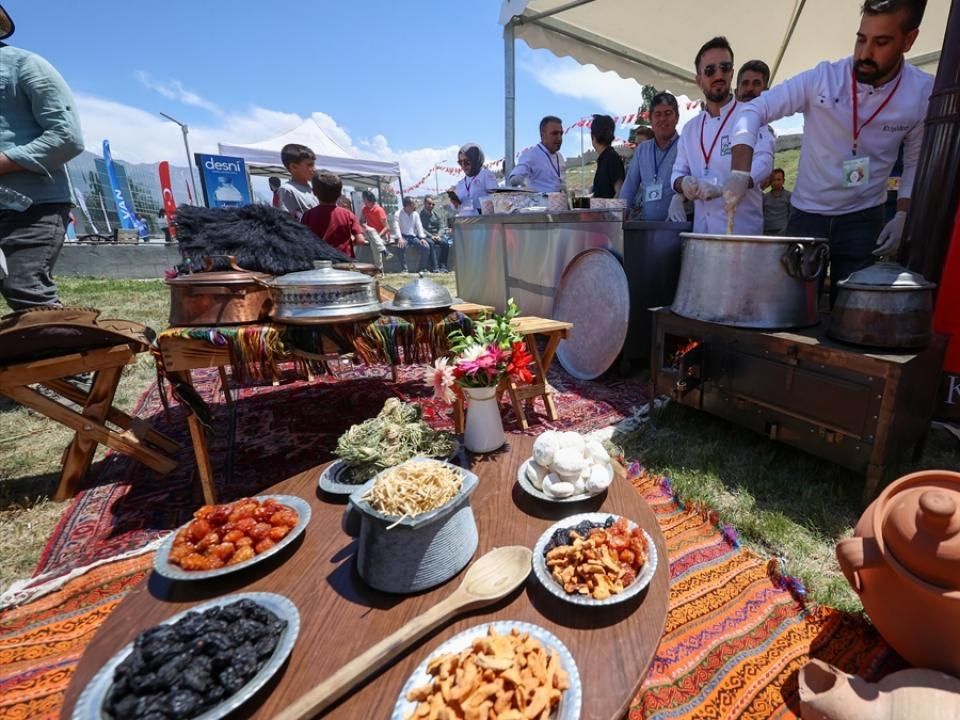
Local dishes at the Kuşhane stand at the Van Gastronomy Festival
Local dishes of Van
- Kavurmalı uşgun ekşilisi (sour rhubarb with fried meat)
- Sengeser
- Kurut aşı (dish with dried yoghurt)
- Kurut köftesi
- Ciğer köftesi (liver köfte)
- Tandır balığı (tandoor-baked fish)
- Ayran aşı (yoghurt soup)
- Kürt köftesi
- Eşkili
- Çırış mıhlası
- Çırış pilavı
- Ayva yemeği (quince dish)
- Helise
- Cılbır (poached eggs with yoghurt)
- Borani (peygamber yemeği)
- Murtuğa
- Otlu peynir (herb cheese)
- Cacık
- Gavut
- Erik kızartması (fried plums)
- Kaşık tatlısı
Source: http://www.nenedirvikipedi.com/yemek-tarifleri/van-ilinin-meshur-yoresel-yemekleri-10384.html

Places to visit in Van
Van, one of the most developed cities in Eastern Anatolia, has many historical and natural treasures waiting to be discovered…
If you have turned your holiday route towards Eastern Anatolia and are thinking of travelling to Van, rest assured that many historical and natural beauties await you. With its unique treasures and deep-rooted culture, Van is one of the places in our country worth seeing. The list of places to visit that we have prepared for travellers getting ready to explore Van will keep you company throughout your journey…
Castles: Van Castle, one of Van's most important monuments, is a must-see on your visit and a regular stop for tourists. Besides Van Castle, left by the Urartians and dating back to 885 BC, Zernek Castle, Ayanis Castle, Hoşap Castle and Çavuştepe Castle are other historic castles you can visit in Van.
Lake Van: Lake Van, Türkiye's largest lake, is one of Van's symbols. Surrounded by countless natural beauties, it will be one of the most enjoyable stops on your trip. Besides Lake Van, Lake Erçek is another lake you can visit.
Akdamar Island: Akdamar Island, in the south of Lake Van, is one of Van's unique beauties. The largest island in Lake Van, it is a regular stop for visitors not only for its natural beauty but also because it is home to the historic Akdamar Church, also known as the Armenian Church of Surp Haç (Holy Cross).
Churches: Throughout history Van has been home to many communities of different cultures and faiths, so on your visit you will come across many churches and mosques. Akdamar Church, the Church of St Bartholomew, the Adır Church on Adır Island, the Kaya Çelebi Mosque, the Hüsrev Paşa Mosque, the Halime Hatun Kümbet, the Süleyman Bey Kümbet, the Twin Kümbets, the Galip Paşa Kümbet and the Hasan Bey Kümbet are among the buildings worth seeing.
Old Van City: Old Van City, where Armenians and Turks lived together until the First World War, is now in ruins and unused. However, there are still historic buildings you can visit. Old Van City lies south of Van Castle.
Hot springs: If you want both to rest and to find healing in Van, we recommend Doğancı Hot Spring in Erciş, Şeyh Cürüh Hot Spring in Çatak, and Kelegom and Dereiçi hot springs in Başkale.
Fairy chimneys: Cappadocia may be the first place that comes to mind when we think of fairy chimneys, but it is not the only place to see these formations. In Van's Başkale district you can also see the Van fairy chimneys and discover these unique natural formations.
Van Museum: The Van Museum, where very important pieces especially from the Urartian civilisation are displayed, is a must on your visit. Displaying manuscripts, handicrafts and old weapons as well as archaeological remains, the museum is in the city centre.
Van Cat House: Another of Van's symbols is the Van cat. The Van Cat House, set up to protect the breed, is on the campus of Yüzüncü Yıl University.
Places to visit in Van: historic sites
Van Cat House

Built and put into service to protect the dwindling Van cats, the Van Cat House is at Van Yüzüncü Yıl University.
At the Cat House, where Van cats, so important for the world's fauna, can now be protected and scientific studies are carried out, female and male cats live in separate sections. There is also a small section for newborn kittens, and sick cats are treated here.
The Van Cat House makes a very enjoyable stop for anyone who wants to see the very different, and very sweet, world of the Van cats playing in the garden.
As you watch the cats playing in the garden, you will want to cuddle every one of them.
Van fairy chimneys

Van, which has many unexplored areas, has fairy chimneys impressive enough to rival Cappadocia.
The Van fairy chimneys were formed by the erosion of rocks thrown out by the volcanic Yiğit Dağı. The area lies within the boundaries of the village of Yavuzlar in Başkale district and is also called "Vanadokya".
Though it is every bit as good as the Cappadocian fairy chimneys, the area is not well known because it has not been widely promoted. Even so, it is named among the important tourism areas of the future.
Old Van City

Old Van City lies south of Van Castle, and with all its remains it is the site of new excavations.
This old settlement of Van was reinforced by walls surrounding it on three sides. From the city's main remains and old photographs, we know the houses here were generally built with one or two storeys. The mosques, churches and all other buildings of Old Van City were in continuous use until the Russian occupation, after which they lost their function. Today only a few buildings survive, in ruins, and sadly only part of the minaret of the Van Ulu Camii (Great Mosque) can be seen.
Although it is abandoned, it is a regular stop for tourists and researchers coming to Van. Archaeological excavations are under way, and new remains come to light every day.
Adır Church

The church on Adır Island in Lake Van, which shares the island's name, is one of the island's historic treasures.
Besides the Adır Church, the island also has a monastery and a chapel. The church is known to have been built in 1621 and stands on the southern part of the island.
Adır Island, which adds to the beauty of Lake Van, should definitely be among your stops for its historic remains.
Adır Island

Adır Island, one of the larger islands of Lake Van, is also called Lim Island.
Adır Island is among the top places to see, both for its historic church and monastery and for its natural beauty. We especially recommend visiting in spring, when the island has become a breeding ground for large numbers of gulls. You should experience the historic atmosphere that pervades the island's nature. After Adır Island, we also recommend visiting Akdamar Island.
Akdamar Church

Akdamar Island offers one of Van's most impressive views. The Church of Surp Haç (Holy Cross) on the island is known by the island's name.
Architecturally striking, Akdamar Church was built between 915 and 921 at the request of King Gagik I. Its architect was a man named Manuel. Akdamar Church is also among the most brilliant works of medieval Armenian art.
The plant and animal motifs on the church's exterior are among its striking details, and this architectural work is now a museum.
Among the first places to see on a trip to Lake Van, Akdamar Church awaits your visit as a museum.
Church of St Bartholomew

The Church of St Bartholomew, in the village of Albayrak within Başkale, is one of the region's rare Christian religious buildings.
Although the date of construction of the Church of St Bartholomew is not known for certain, there are views that it was built in the 3rd century. It is one of the city's impressive buildings, and restoration work has begun with the aim of opening it to tourism. The decoration on the church's walls has kept its original character to the present day, and it is also a building with high tourism potential. After the Church of St Bartholomew, which we recommend you see on your Van trip, you can add other important works of the city such as Van Castle, Şeytan Köprüsü, Muradiye Waterfall and the Hüsrev Paşa Mosque to your list.
Şeytan Köprüsü (Devil's Bridge)

Şeytan Köprüsü, on the Bendi Mahi stream in Van, has an enchanting structure.
There is no certain information about when Şeytan Köprüsü, which bears traces of the city's rich history, was built, but it is thought to have been built by the Ilkhanid rulers in the 13th century, because the Ilkhanid rulers used this area for travelling to and from Tabriz. Located in Muradiye district, the bridge is built on two rocks and is still sound and in use. The water rushing between the two rocks makes the bridge all the more imposing. We recommend you see Şeytan Köprüsü on your Van trip, and don't forget to take photographs when you visit this bridge, one of the most worth-seeing places in Van, a city with a rich history. Hurkan Bridge is another of the city's bridges worth seeing.
Hurkan Bridge

With its rich historic remains and eye-catching natural beauty, Van is one of the most beautiful parts of Eastern Anatolia: the Kaya Çelebi Mosque, the Hüsrev Paşa Mosque, Akdamar Island, Muradiye Waterfall, Lake Erçek…
Van, with its many places to visit, also draws its visitors' attention to Hurkan Bridge. The bridge is thought to have been built between the 17th and 18th centuries, by the Ottoman state. Rubble stone and cut stone were used in its construction, and it underwent a major repair in 1988. Hurkan Bridge is among the works that have witnessed the city's history; today it is one of Van's places to see and is still in use. If you are planning a trip to Van, you can add Hurkan Bridge to your list. Impressive for its solidity and architecture, Hurkan Bridge spans the Çatak stream near Çatak district. After visiting Hurkan Bridge you can go on to other historic and natural sites. Şeytan Köprüsü is also among the city's historic bridges.
Halime Hatun Kümbet

The Halime Hatun Kümbet in Van's Gevaş district is among the city's must-see buildings.
Located near the Seljuk cemetery in Gevaş, the Halime Hatun Kümbet dates back to 1335. Melik İzzeddin had the tomb built for his daughter Halime Hatun, and its master builder was Esed, son of Pehlivan, from Ahlat. The twelve-sided tomb has a pyramidal conical roof and is built of smooth cut stone. All its façades bear plant, geometric and inscription decoration. We recommend including the Halime Sultan Kümbet in Gevaş, one of Van's historic treasures, in your trip. The Hüsrev Paşa Mosque, Ayanis Castle and Muradiye Waterfall will also be waiting for you.
Kaya Çelebi Mosque

The Kaya Çelebi Mosque is one of the 17th-century works. Like the Hüsrev Paşa Mosque, it is in old Van's Orta Kapı neighbourhood.
Construction of the Kaya Çelebi Mosque was begun in 1660 by Kaya Çelebizade Koçi Bey, and after Koçi Bey's execution it was completed by Cem Dedemoğlu Mehmet Bey. Having earned its place in Van's rich history, the mosque is one of the first places visited by tourists coming to the region. Besides this building, Zernek Castle, Ayanis Castle, Hurkan Bridge, Lake Van and Muradiye Waterfall are also among the places people are curious about. The mosque's interior and exterior architecture will captivate you. The plant and geometric decoration on the doors and windows of this single-balcony mosque is fascinating enough to win your admiration. If you are planning a trip to Van, we recommend you make sure to see the Kaya Çelebi Mosque.
Hüsrev Paşa Mosque

The Hüsrev Paşa Mosque, one of the works of Mimar Sinan, is part of the Hüsrev Paşa Külliyesi in Van.
According to its inscription, the Hüsrev Paşa Mosque was built in 1567 by Köse Hüsrev Pasha, the beylerbey (governor-general) of Van. Cut stone, squinches and brick were used in the construction of this mosque, one of Mimar Sinan's works.
The tiles inside are still impressive. Another striking interior detail is the mihrab in the middle of the qibla wall. Excavation and restoration work is also being carried out at the mosque.
Among the first places you should see in Van, the Hüsrev Paşa Mosque is in the Orta Kapı neighbourhood and is very easy to reach. After it, we recommend the Kaya Çelebi Mosque, Ayanis Castle, Hurkan Bridge, the Halime Hatun Kümbet, Zernek Castle and Muradiye Waterfall.
Zernek Castle

Zernek Castle, one of Türkiye's historic treasures that has managed to survive to the present day, is in Gürpınar, Van. It has the character of an inner citadel, and to its east is the mansion where the Bey of Zernek once lived.
Although there is no certain information about the castle, it is thought to have been built by İbrahim Beyoğlu, one of the mirs (lords) of Zernek. Perched on a steep rock, Zernek Castle can be one of the impressive stops on your Van trip. Although much of the castle has collapsed, it is still worth seeing. It is built of rubble stone and has 4 storeys. After visiting Zernek Castle, which reflects the history of Eastern Anatolia, you can set out to discover the city's other historic and natural beauties. Lake Erçek, Akdamar Island, the Hüsrev Paşa Mosque, Ayanis Castle and Lake Van are among the places we recommend.
Ayanis Castle
Van, one of the cities of Eastern Anatolia, wins the admiration of all who see it with its historic and natural beauties. Akdamar Island, the Hüsrev Paşa Mosque, the Halime Hatun Kümbet, Lake Erçek, Zernek Castle and Hoşap Castle are among the city's most worth-seeing places.
Another building that has witnessed Van's history is Ayanis Castle. It is only 35 kilometres from the city centre and stands 250 metres above Lake Van. In 1989 an excavation was carried out under Prof. Dr A. Çilingiroğlu of the Department of Near Eastern Archaeology at Ege University's Faculty of Letters. The excavations uncovered architectural structures and small finds, each of which has yielded important information about the castle's history. According to the inscription found, the castle was built by Rusa, son of Argishti.
Dating back to 645–643 BC, Ayanis Castle also provides important information about the Urartian period. If you have a special interest in historical trips, you can visit Ayanis Castle.
Akdamar Island
Akdamar Island is among the first places you should see on your Van trip. On Akdamar, the largest island in Lake Van, there is a church built by Armenians. The island covers 70,000 square metres. It has a beautiful legend, from which its name comes.
Once upon a time an Armenian monk had a daughter, the most beautiful of the beautiful, named Tamara… She and a young shepherd who tended his flock near the island fell in love. Every night the young shepherd would swim to the island to meet Tamara, and she would light a lantern to show him where she was. One day the girl's father learned of this love and of how his daughter met the shepherd. One night, as his daughter went to meet him again, the father followed her. As the young shepherd swam, the monk kept signalling with a lantern from the shore of the island. As the light began to appear from different places, the shepherd, swimming on and on, lost his strength. Exhausted, he began to sink. His last words were "Ah, Tamara!" Hearing her beloved's voice, Tamara realised they had fallen for her father's trick, and threw herself into the lake. The two young people drowned, but their bodies met in Lake Van.
That is the story. Over time the place known as Ahtamar became Akdamar. We recommend you go to Akdamar Island, the setting of this beautiful legend, on your Van trip. Afterwards you can add Hurkan Bridge, Ayanis Castle, Zernek Castle, Lake Erçek and Van Castle to your list.
Hoşap Castle
Hoşap Castle, one of the historic treasures of Gürpınar district, stands on a steep slope.
Sixty kilometres from central Van, Hoşap Castle has rich historic remains. A mosque, an old hamam, a madrasa, a cistern, a dungeon and rooms have survived inside the castle. Many of the remains of this medieval castle were built in the time of the Mahmudi beylik, which was subject to the Ottoman state. Like Çavuştepe Castle, Hoşap Castle's history goes back to the Urartian period, and because it stood on the road between Iran and Türkiye it had strategic importance in earlier times. After visiting Hoşap Castle on your Van trip, we recommend Muradiye Waterfall, Ayanis Castle, Van Castle and Lake Erçek. The city's rich history and natural beauty will give you an unforgettable journey.
Çavuştepe Castle
Çavuştepe Castle, an Urartian castle set on a hill of the Bol Mountains, is within Van province. Archaeological excavations and research have been carried out at the castle, 10 kilometres from Gürpınar and 25 kilometres from Van, revealing the lower and upper citadels and the main entrance gate. Çavuştepe Castle is known to have been built at the height of Urartian power, for military and economic purposes. Many remains at the castle are still waiting to be discovered. Having witnessed a rich history, Çavuştepe Castle can be an impressive stop on your Van trip. You can continue your journey of discovery by visiting the city's other riches: Van Castle, Lake Van, Lake Erçek and Muradiye Waterfall should be on your list.
Muradiye Waterfall
An important part of Eastern Anatolia's natural beauty, Muradiye Waterfall is a favourite spot for both relaxing and having fun.
Muradiye Waterfall in Van generally draws great interest from nearby cities: people from Bitlis, Muş, Hakkari and Batman come in summer for picnics and to cool off. If you find yourself in Van, you should definitely visit it. This natural wonder in Muradiye will also amaze you with the places to explore around it. Adding something of its own to both the history and the natural beauty of Eastern Anatolia, Muradiye Waterfall has recently begun to attract great interest from foreign tourists too. There are trout restaurants near the waterfall, which is one of Türkiye's most attractive spots. You can also include the Halime Hatun Kümbet, Van Castle, the Hüsrev Paşa Mosque, Çavuştepe Castle, Lake Erçek and the Van Museum in your city tour.
Lake Erçek
Lake Erçek is a dammed lake. One of the beauties of Eastern Anatolia, it lies 30 kilometres east of Lake Van.
Its surface area is 114 km², and it is also the largest lake after Lake Van. Its water is soda-rich and salty. The area hosts the Lake Erçek Flamingo Festival every year.
Lake Erçek, home to 210 of Türkiye's roughly 450 bird species, has no fish at all. You can include Lake Erçek among the places to visit on your Van trip. The Van Museum, Ayanis Castle, Akdamar Island, Zernek Castle, Çavuştepe Castle, Muradiye Waterfall and Van Castle are also places you should see.
Van Castle
Van Castle is a fortification built of massive stone by the Urartian Kingdom, overlooking the Urartian capital Tushpa from above. On the shore of Lake Van, 5 km from the city, it is built on a steep rock.
The structure is 1,800 m long, 120 m wide and 80 m high. The castle was founded in the 9th century BC by Sarduri, son of Lutipri, between 840 and 825 BC. Many fortifications of this kind are found in present-day Armenia, Türkiye and Iran.
Such structures are generally built on outcrops of rock and into hillsides. Castles of this kind were generally used not to resist foreign armies but to control the region. The ruins of this structure on the outskirts of Van support the view that its walls were built in the Middle Ages.
Lake Van
Lake Van, called the Van Sea, is thought to have formed as a result of the eruption of Mount Nemrut. It lies within the boundaries of Tatvan district and covers 3,713 km². Its water is salty and soda-rich, and its level rises and falls with the seasons. The lake has the islands of Akdamar, Çarpanak, Kuş and Adır, which are visited by tourists. As it is a closed basin, its water is lost through evaporation, which causes salt to build up in the lake.
The lake is important for soda production, and plenty of fish live at the river mouths. Only melting snow from the mountains feeds the lake. With its natural features and islands, Lake Van is one of the places to visit. Never put off seeing Türkiye's natural beauty.
Van Museum
The Van Museum is a place where we can learn about Van's history and cultural heritage. Located on Hacıosman Street in the Şerefiye neighbourhood, it has a wide-ranging collection.
All the archaeological pieces in the museum, founded in 1972, are arranged chronologically, so you can see historic pieces from prehistory to the Urartian period. You can also see finds from excavations at sites such as Tilkitepe, Kızdamı, Van Castle, Anzaf Castle, Toprakkale and Çavuştepe. The museum garden is laid out as an open-air museum.
The Van Museum also has sections displaying ethnographic pieces. Here, Van-made silver belts, local kilims, bracelets, necklaces and tobacco boxes reveal the city's culture and traditions.
Source: http://www.gezilebilecekyerler.com/vanda-gezilecek-yerler/
Culture and arts in Van
Van culture brings to mind the Van cat, Van otlu peynir (herb cheese) and the Van breakfast.
Otlu peynir is made with milk from domestic animals and herbs gathered locally. The city centre has a cheese market more than fifty years old.
The Van Cat House at Yüzüncü Yıl University protects three different types of Van cat.
Cultural venues support tourism; Iranian visitors are a notable group among the city's tourists.
History of Van
Van was the centre of the Urartian state. The Urartians called their capital Tushpa; Sarduri I founded the city and made it the capital. Van Castle, built by Sarduri, was the political centre of Urartu.
The castle's longest inscription, the Horhor Inscription, is at the entrance to King Argishti's tomb. The function of the Madır Tower west of the castle is unknown; it is thought to have been used as a harbour.
The Seljuks entered the region in 1064. The Safavids took Van in 1507, and Ottoman control was secured by the Treaty of Kasr-ı Şirin (Zuhab) in 1639.
Akdamar Church, from the seventh century, is an Armenian church built to house an important relic. Also known as Surp Haç, it is one of the symbols of Van.
Getting to Van
The means of transport you choose to get to Van depends on which city in Türkiye you are coming from. If you are coming from Eastern or South-eastern Anatolia, the distance is short, so you can drive or take an intercity bus. Erzurum to Van takes about 5 hours by car, and Diyarbakır to Van 4 hours 45 minutes.
If you want to drive from Ankara to Van, the journey takes an estimated 15 hours. From Istanbul to Van by car it takes about 19 hours. If you are travelling in winter, we advise you not to set out without winter tyres and chains, given the road conditions.
As well as by road, Van can be reached by air and rail. The Van Gölü Express leaves Ankara every Tuesday and Sunday and reaches Tatvan in about 26 hours; from Tatvan you can reach Van by bus or ferry. For a faster journey, you can use Van Ferit Melen Airport, 8 kilometres from the city centre. Built on the shore of Lake Van, Ferit Melen Airport has been an important link between Van and other cities since it opened in 1943. With daily flights from Istanbul you can reach Van in 1 hour 30 minutes. Those coming from abroad can fly to Van with a connection in Istanbul.
Districts of Van
- Bahçesaray
- Başkale
- Çaldıran
- Çatak
- Edremit (Gümüşdere)
- Erciş
- Gevaş
- Gürpınar
- Merkez (central district)
- Muradiye
- Özalp
- Saray
Economy of Van
Van's economy is based mainly on livestock and farm produce, and this is reflected in its cuisine. One study notes that the province ranks first in Türkiye for sheep and goat farming, but that production is declining.
Van's location favours cross-border trade and tourism. Iranian visitors are important for the city's shopkeepers; it has been noted that only the Kapıköy crossing is currently operating on the Iranian border.


Comments
Loading comments…